Laundry that comes out of a Miele soaking wet, heavy enough to drip on the way to the dryer, is almost always a spin problem rather than a wash problem. An F53 Miele washing machine fault says the tacho signal that reports drum speed has gone missing or unreliable, and without that signal the control refuses to drive the drum to full spin. F56 states the outcome directly: the final spin speed was too low. F104 reports low drive voltage.
Miele displays some of these as a technical fault with the number beside it, which reads as though the whole machine has failed. It has not. Three of the four numbers below concern the drive and the signal that measures it, and that is a defined, repairable part of the machine.
What does F53 mean on a Miele washer?
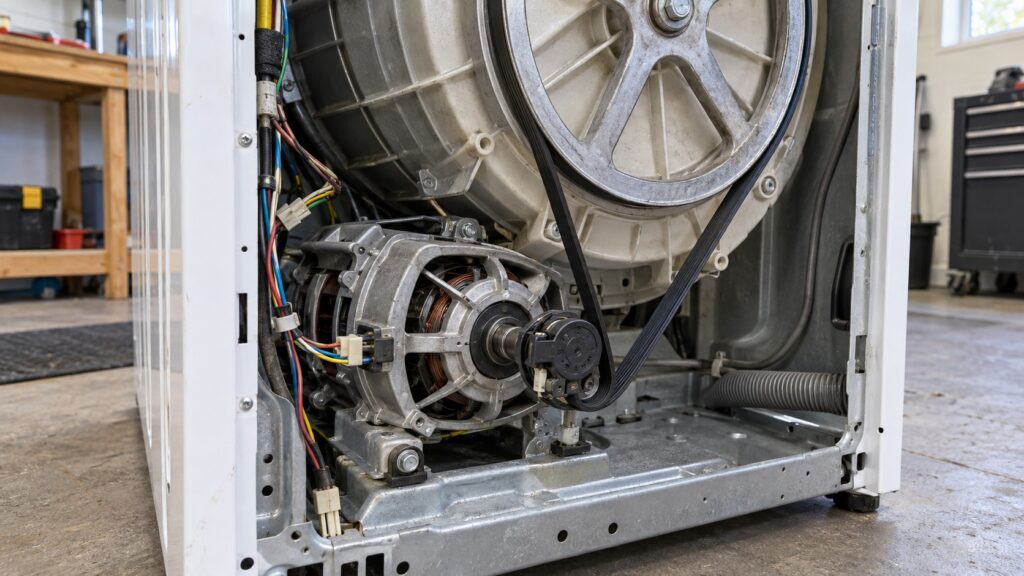
The tacho is a small speed sensor at the motor. Every spin the machine performs is closed-loop: the control commands a speed, the tacho reports the actual speed, and the drive corrects the difference many times a second. Remove that feedback and the machine has no safe way to run a drum at over a thousand revolutions a minute with an unknown load inside it. So it does the conservative thing and stops trying.
The same number means other things on other Miele appliances — a circulation-pump speed sensor on a dishwasher, a motor tacho on a dryer — so make sure you are reading the washer entry. The detail sits on the code page for F53 on a washer, and the neighboring numbers are on F56, F104 and F63.
Why does wet laundry sometimes come with no code at all?
Because the machine can fail to spin properly while every component is working. Three ordinary causes account for most of it:
- Imbalance. One heavy item — a bath mat, a comforter, a pair of jeans — settles to one side. The machine detects the wobble, refuses the high-speed ramp and finishes at a lower speed on purpose.
- A partial drain. Water still in the tub prevents the spin from starting. That is a drainage matter, and our guide on F11 and drainage covers it.
- Overloading. A drum packed to the door cannot redistribute the load at all, so the balance routine never succeeds.
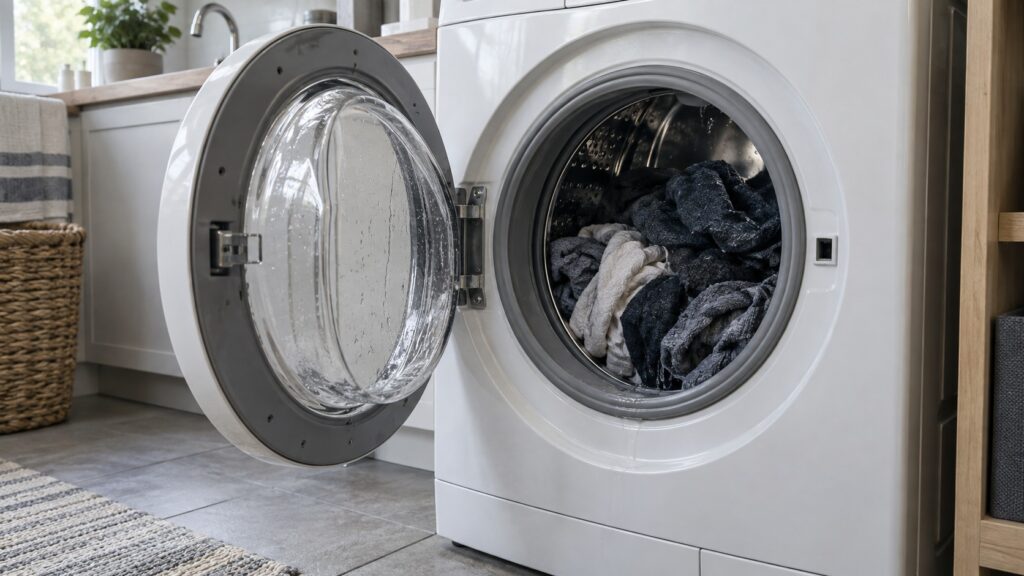
The useful test is a single towel. Run a short spin program with one damp towel in an otherwise empty drum. If that spins to full speed and comes out nearly dry, the drive is healthy and your problem is load, balance or drainage. If even one towel will not spin, the fault is in the machine.
How is this different from a machine that vibrates?
Vibration and failure to spin feel related and are usually not. A washer that walks across the floor or booms during spin is telling you about suspension, transit bolts or a floor that flexes, and it typically spins to full speed while doing it. A drive or tacho fault does the opposite: the machine is quiet, the drum turns slowly and the cycle simply ends. Our guide to a vibrating Miele washer handles the mechanical side, which is worth ruling out first because it costs nothing.
Listen for one more thing. A drive fault that is developing often produces a brief high whine as the drum tries to accelerate and then gives up, repeated two or three times in a cycle. That sound is the control attempting the ramp, losing confidence in the feedback and backing off.
What can you check safely?
- Run the single-towel test described above. It separates a machine fault from a laundry fault in ten minutes.
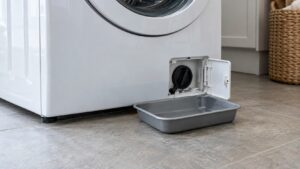
- Clean the drain filter. The flap at the lower front opens without tools; keep a shallow pan and a towel ready. A slow drain caps spin speed long before it raises a code.
- Cut power at the breaker for five minutes. Long enough for the control to drain, not a quick flick of the switch.
- Check the machine is level and the transit bolts are out. Bolts left in from a move are still, decades in, the most common reason a Miele never spins properly from day one.
- Look at the circuit. A low drive voltage code deserves a look at what else is on the same breaker, and at whether an extension cord is involved. It should not be.
Stop at the back panel. The motor, the tacho and the drive electronics sit behind it, the machine has to be moved and tipped to reach them, and there is stored charge in the drive for some minutes after the power is cut. This is the part of a washer that is genuinely worth leaving alone.
Is a drive fault worth repairing on a Miele?
More often than on most brands. A tacho sensor is an inexpensive part, it is accessible without splitting the tub, and on the W1 family the drive electronics are a separate module from the main control. A fifteen-year-old machine with sound bearings and a failed speed sensor is a straightforward repair, and these machines are built to run considerably longer than that. The case turns the other way when the bearings are also noisy, because a bearing job on a sealed tub is the one Miele repair that regularly costs more than the machine is worth. Our repair or replace guide works through both cases.
We are an independent repair company, not a factory service arm, and we will tell you when a repair is not worth doing. Pricing starts from a diagnostic visit, from $89 in most of our service area, and we confirm the estimate before any work begins.
If the single towel will not spin, Miele washer repair covers the drive, the tacho and the electronics behind it. Schedule a visit with the code, the program you were running and whether the drum ever reaches high speed, and read our Miele washer tips for the loading habits that keep spin speeds where they should be.