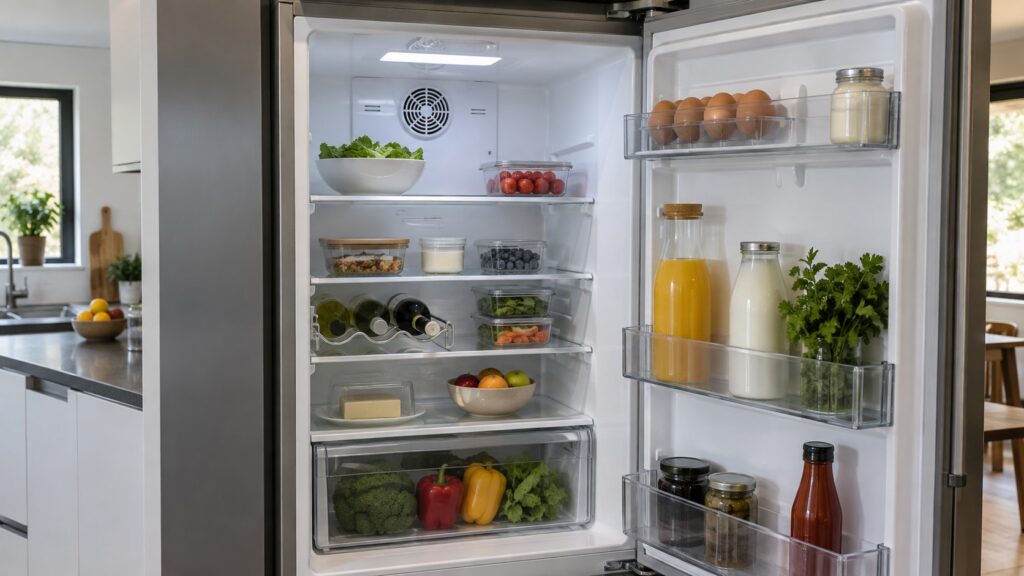
Miele DynaCool is a fan-assisted cooling system built into Miele refrigerators that actively circulates air through the cabinet instead of relying on a still, passively cooled interior. The practical effect is that a DynaCool refrigerator holds a much more even temperature from the top shelf to the bottom drawer, rather than the warmer-at-the-top, colder-at-the-back pattern that shows up in a static-cooled fridge.
What does Miele DynaCool actually do inside the fridge?
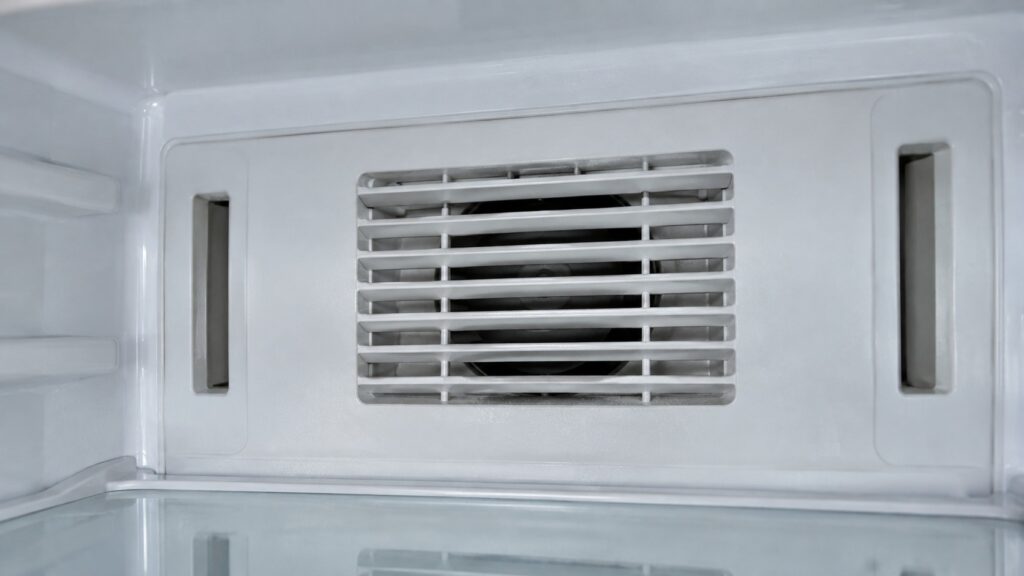
Miele DynaCool takes over a job that a static refrigerator leaves to gravity. In a cabinet without forced air movement, cold air sinks and settles near the bottom and back, while the door and upper shelves run several degrees warmer — sometimes enough to matter for food safety on delicate items stored on a high shelf. Miele DynaCool uses a fan to actively push cooled air around the cabinet, so every shelf sits much closer to the same temperature rather than each shelf being its own small climate. The fan typically sits at the back of the cabinet near the evaporator, drawing air across the cold surface and distributing it through vents positioned at different heights rather than letting it pool at the bottom.
How is DynaCool different from static/passive cooling?
Static cooling has no moving air at all inside the cabinet: a single cold surface or coil chills the air nearest to it, and that air spreads by convection alone, which is slow and uneven. DynaCool’s fan turns that slow drift into active circulation, so the whole interior tracks the thermostat’s set point far more closely. It is the same underlying idea Miele applies to frost prevention in its no-frost freezers — moving air rather than letting cold settle — which we cover separately in how Miele NoFrost freezing works, though DynaCool’s job is even temperature rather than frost control specifically.
The distinction matters for anyone comparing refrigerator specifications side by side, because “cools evenly” and “cools to a set temperature” are not the same claim. A static refrigerator can hold its average or its coldest point at the target temperature perfectly well while still running several degrees warmer near the door and cooler near the back — DynaCool is aimed specifically at closing that internal gap, not at making the compressor work harder or colder overall.
Does DynaCool use more energy than static cooling?
Running a small circulation fan does draw a modest amount of additional power compared with a cabinet that moves no air at all, but the more relevant comparison is efficiency at the compressor level, not the fan alone. Because DynaCool keeps the whole cabinet closer to the target temperature rather than letting the compressor chase a wide swing between warm and cold zones, the system as a whole tends to run efficiently rather than compensating for uneven distribution with a colder average setting.
Why does even temperature matter for what I store where?
On a static refrigerator, the shelf placement advice people give — meat lower, dairy mid-shelf, produce in the crisper — exists partly to compensate for real temperature differences between zones. A Miele refrigerator with DynaCool narrows those differences, so shelf placement matters less for temperature and more for humidity and airflow around individual items. It does not mean every shelf is identical (the door is still the warmest area on any refrigerator, DynaCool or not), but the gap between the coldest and warmest interior shelf is meaningfully smaller.
This also means a DynaCool refrigerator recovers temperature faster after the door has been open, or after a large grocery load goes in at room temperature, because moving air redistributes the cold load across the cabinet rather than waiting for it to spread on its own. That recovery speed is one of the more noticeable everyday benefits of the system, even for someone who never thinks about airflow directly — groceries brought home from a warm car cool back down across every shelf at roughly the same rate, rather than the shelf nearest the vent recovering quickly while a shelf on the door side lags behind for hours.
Can a blocked cabinet defeat DynaCool?
Yes, and this is the most common way a DynaCool refrigerator ends up with the same uneven-temperature complaint the system is designed to prevent. The fan pushes air along defined paths through the cabinet, and tall containers, dense stacking against the back wall, or items pressed against a vent opening can block that path just as effectively as if the fan were not running at all. If one shelf or drawer consistently runs warmer than the rest despite DynaCool, check for anything blocking a vent before assuming a fault.
What does it mean if the DynaCool fan stops or gets noisy?
A DynaCool fan that has gone quiet, or one that has started buzzing or rattling, is a mechanical fault worth addressing rather than living with — once circulation stops, the cabinet reverts to something closer to static cooling and the temperature spread across shelves widens again, even though the compressor is still running and the fridge still feels “cold enough” in general terms. Ice buildup around the fan blade, a worn bearing, or a fan motor nearing the end of its life are the usual causes.
If your Miele refrigerator is not holding temperature evenly, start with our Miele refrigerator tips for the loading and airflow habits that keep DynaCool working as intended, and read our repair-or-replace guide if the unit is older and the fan is one of several things showing wear. A new build should follow our installation guide so ventilation clearances do not undercut DynaCool from day one.
Our technicians diagnose circulation-fan and airflow faults as part of Miele refrigerator repair, and we confirm the estimate before any work begins — we are an independent repair company, not a factory service arm. Schedule a visit if a shelf or drawer keeps running warmer than the rest.