A Miele refrigerator with NoFrost never needs defrosting, and the reason is not that frost is prevented from forming. Frost forms exactly as it always did — on the evaporator, hidden behind the rear wall — and the appliance removes it on a schedule you never see. Understanding that one fact explains almost every question people ask about these units, including why the compartment sometimes clicks, hums or runs a little warmer for twenty minutes.
How Miele NoFrost actually works
Cold air in a NoFrost freezer is not made by the walls. It is made by an evaporator coil tucked behind the rear panel, and a fan blows air across that coil and out into the compartment through vents. Because the cold surface is hidden, the moisture that air carries condenses and freezes there, on the coil, rather than on your food or on the visible walls.
Left alone, that coil would ice up solid within days and the fan would stop moving air. So the control board runs a defrost cycle: the compressor stops, a small heater warms the evaporator just enough to melt what has accumulated, and the meltwater runs down a drain channel into a tray sitting near the compressor, where it evaporates from the heat the compressor already produces. Then cooling resumes. The whole thing takes twenty to thirty minutes and happens a few times a day.

Why the compartment is dry, and what that means for food
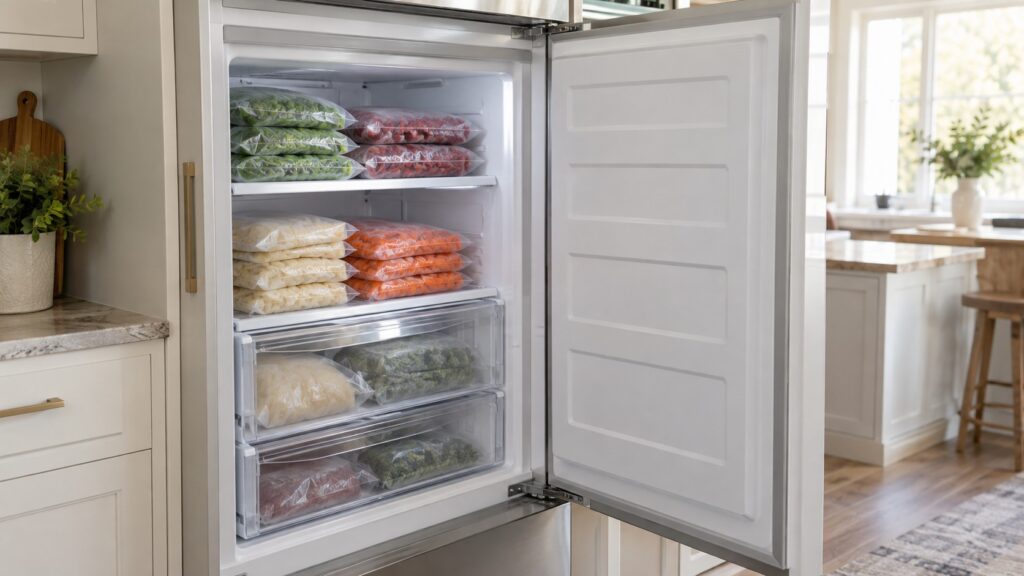
Every defrost cycle removes water from the compartment for good. That is precisely what keeps the walls clear — and it is also why a NoFrost freezer is a dry environment. Food left unwrapped, or wrapped loosely, loses moisture to that dry air. What people call freezer burn is this, not a fault.
The practical rules follow directly:
- Wrap tightly. Air contact is the enemy, not time. Sealed bags with the air pressed out beat rigid boxes with a gap at the top.
- Do not overfill the vents. The fan needs a path. A carton pushed flat against the rear vents starves the compartment of cold air, and the symptom looks like weak cooling.
- Expect a short warm swing. During defrost the compartment rises by a degree or two. That is designed behavior and food does not thaw.
The sounds that are normal, and the one that is not
A NoFrost unit is mechanically busier than a manual-defrost freezer, so it makes more noise. A fan running whenever the compartment is cooling is normal. Ticking or light cracking as the evaporator heats and then cools again is normal — metal expanding and contracting. Water trickling shortly after those ticks is the meltwater reaching the tray, and it is also normal.
What is not normal is frost returning to the visible walls or to your food. That means either warm humid air is getting in past a door seal, or the defrost system itself has stopped working — a failed heater, a failed sensor, or a drain channel blocked with ice so the meltwater cannot leave. Our guide on frost buildup in a Miele refrigerator covers how to tell those apart, and water on the floor is usually the same drain channel telling you about itself in a different way.
What the cycle costs, and why the unit runs more often
A defrost cycle puts heat into a compartment whose whole job is to stay cold, so the compressor has to remove that heat afterwards. This is the honest trade behind never defrosting by hand: a NoFrost unit runs its compressor somewhat more than a manual-defrost freezer of the same size, and it is mechanically busier because it also runs a fan. Against that, a manual-defrost freezer loses efficiency steadily as ice thickens on its walls — an ice layer is an insulator, and half an inch of it makes the compressor work harder every hour of every day until you chip it off.
Two practical consequences follow. A NoFrost freezer that seems to run often is usually behaving normally, especially in a warm kitchen or shortly after a large shop has gone in. And a NoFrost freezer that runs constantly, with no quiet periods at all, is saying something different — either the door is not sealing, or the defrost system has stopped clearing the coil and the fan is pushing air across a block of ice.
NoFrost, DynaCool and MasterFresh are three different things
These get mixed up constantly, and the distinction matters when you are describing a problem. NoFrost belongs to the freezer side and is about defrosting. DynaCool belongs to the fresh-food side and is a fan that evens out temperature so the top shelf and the bottom drawer are closer together. MasterFresh is a controlled zone for produce and proteins, held near freezing at a chosen humidity. A unit can have all three, and a fault in one says nothing about the others. Our explainer on how MasterCool and MasterFresh work covers the fresh-food side in detail.
What you can check, and what needs a technician
If the freezer is frosting up, three checks are safe and often decisive. Look along the door seal for a gap, a fold, or a spot that no longer grips a sheet of paper. Check that nothing is blocking the rear vents. Confirm the door is actually closing — a drawer pushed out by a fraction of an inch holds it open all night without ever showing an alarm.
Past that, the defrost heater, the defrost sensor and the drain channel sit behind the rear panel of a compartment full of frozen food, alongside refrigerant lines. That is a service job, and on a Miele column it is a service job with a sealed cabinet around it. We are an independent repair company, not a factory service arm; pricing starts from a diagnostic visit and we confirm the estimate before any work begins. Miele refrigerator repair covers the defrost system, and you can schedule a visit online. For day-to-day habits, our Miele refrigerator tips cover the ones that matter most.