The Miele range repair or replace decision usually comes down to which part has failed rather than how old the range is. A control board, an igniter or spark module, an induction coil module, or an oven temperature sensor are the four failure points that most often trigger the question, and on a Miele range — priced and parted at a higher tier than most of the market — the honest answer depends heavily on which of those four you are looking at and how old the range already is when it happens.
What actually fails most often on a Miele range?
Four components account for most of the repair calls we see on Miele ranges. The oven’s temperature sensor — the same part behind the F05/F06/F07/F09 fault family we cover in our guide to those sensor codes — is common, inexpensive to replace, and rarely a reason to consider replacing the appliance. On gas models, the igniter or spark module that lights the burners wears with use and is a normal part-replacement item. On induction models, an induction coil module can fail in a single zone while the rest of the range works normally. And the control board, which coordinates everything else on the range, is the one failure on this list that tends to raise the bigger question.
Why is a control board failure often the tipping point?
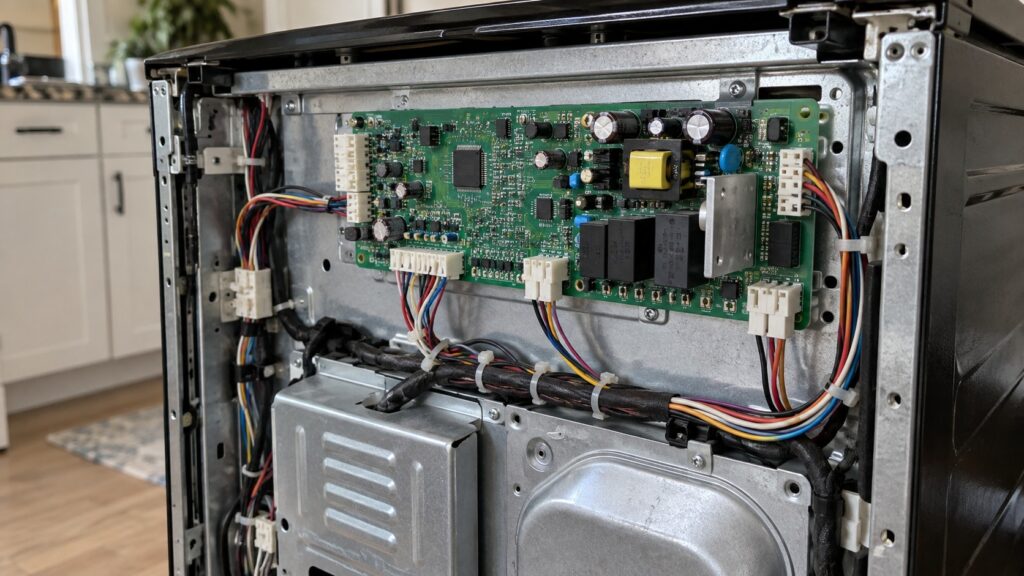
A control board failure on an older Miele range tends to be the moment repair-or-replace conversations turn serious, for two reasons. First, the board itself is one of the more expensive individual parts on the range, and Miele’s parts and labor generally sit at a higher price tier than mainstream brands, so the repair cost is not trivial even on its own. Second, and more importantly, a board failure on a range that has already had a few years of use often arrives alongside other components that are quietly nearing the end of their own service life — an igniter that sparks a little slower than it used to, a coil module that runs slightly hot, a door seal past its prime. None of those individually would justify replacing the range; a board failure that forces the question tends to surface all of them at once.
How does Miele’s higher parts and labor cost change the math?
Because genuine Miele parts and the labor to install them typically cost more than the equivalent repair on a mainstream brand, the age and failure-type thresholds that make sense for a budget range do not transfer directly to a Miele one. A repair that would be an easy call on a less expensive range — replace the part, keep the appliance — needs a slightly more careful look on a Miele range once the part in question is a major one like a control board or an induction module, simply because the repair bill itself is a larger fraction of what a new range would cost.
That said, higher part cost does not automatically tip the answer toward replacement. A Miele range is also generally built for a longer service life than a mainstream range, so a repair that keeps a well-maintained ten-year-old Miele running is very often still the better value than starting over with a new appliance, even at Miele’s price tier.
At what age does replacing a Miele range make more sense than repairing it?
There is no single number that applies to every range, but a rough pattern holds across the failures we see most: under about ten years old, repair is almost always the better value regardless of which of the four components has failed, because the rest of the range still has substantial life left in it. Past about fifteen years, a major-part failure — a control board or an induction module especially — is worth weighing seriously against replacement, particularly if it is not the first significant repair the range has needed. Between those two points, the decision leans on which part failed and whether anything else on the range is already showing its age.
Does a gas range and an induction range fail differently enough to matter?
Yes, in one important way: a gas range’s most common wear item, the igniter or spark module, is a comparatively minor and inexpensive repair at almost any age, which keeps gas ranges leaning toward repair longer than the induction coil failure pattern does. An induction range’s coil module failure is a more consequential repair, closer in weight to a control board failure than to an igniter replacement, so an induction range reaching a coil failure at an advanced age is more likely to prompt a genuine replacement conversation than a gas range with a worn igniter at the same age.
Is a refurbished control board worth considering instead of new?
Sometimes, but treat it as a cost-versus-risk decision rather than an automatic win. A refurbished or remanufactured control board can cost meaningfully less than a new one, which changes the math on an older range where a new board’s price alone might tip the decision toward replacement. The tradeoff is the part’s own reliability and warranty: a refurbished board with a short or no warranty carries more risk of a repeat failure than a new part, and a second repair visit for the same fault erases whatever you saved on the part itself.
Ask specifically about the warranty length on any refurbished part before agreeing to it, and weigh that against the range’s overall age — a refurbished board on a range that is otherwise in good shape and under about ten years old is a reasonable way to bring the repair cost down, while the same part on a range already past fifteen years is better judged against the full replacement question rather than treated as a shortcut around it.
What should I check before deciding either way?
Start by confirming exactly which component has actually failed rather than guessing from the symptom — a range oven that will not heat and a burner that will not stay lit point at very different parts with very different repair costs, so an accurate diagnosis is the first real input into the repair-or-replace decision, not an afterthought. If you are leaning toward replacement regardless, our range buying guide covers choosing a new model.
Our technicians diagnose all four of these failure points as part of Miele range repair, and we tell you plainly when a repair is not worth doing rather than defaulting to one answer. We are an independent repair company, not a factory service arm, and we confirm the estimate before any work begins. Schedule a visit and we will give you the honest number for your specific range.