Miele reuses the same fault numbers across its appliances, and the number on its own does not tell you which part is at fault. An F11 on a washing machine and an F11 on a dishwasher both describe a drainage problem, but they point at different pumps, different filters and different checks. When you search a bare code, you can easily land on the page for the wrong machine and start taking apart a component that was never involved.
Why one Miele error code means several things
Miele error codes are grouped by function rather than by part, and that single design decision explains the whole problem. The service electronics assign numbers to functions. A number in the F10–F19 band describes something about water coming in or going out; the F50–F69 band covers motors, pumps and the parts that report their own speed. Because a washing machine, a dishwasher and a dryer all contain motors and pumps, the same slot in that scheme gets reused. The appliance decides what the number resolves to.
The practical consequence is that Miele error codes are only half an address. The number tells you which functional group is complaining; the appliance tells you which component sits in that group. Read either one alone and you are guessing.
That is also why the plain-English message on the display matters more than the number. Miele pairs its codes with short phrases such as Drainage problem or Waterproof system. If the display shows a phrase alongside the code, trust the phrase first: it is appliance-specific in a way the number is not.
Start with the appliance, then the code
The fastest way to avoid a wrong diagnosis is to reverse the usual order. Do not look up the number and then decide which machine it applies to. Identify the machine, open that appliance’s code list, and read the entry there.
- Washing machines. Start from the Miele washer error codes list. W1 machines report codes together with a plain message, so you usually have two signals to work with.
- Dishwashers. The dishwasher code list covers the F11 to F19 water group, which is where most repeat calls come from.
- Dryers. T1 heat-pump dryers share numbers with washers but almost never share causes; airflow and the heat exchanger dominate.
The three codes that cause the most wrong turns
F11. Both readings mean water is not leaving the machine, so the symptom looks identical: standing water and a stopped cycle. The parts differ. On a washer the drain pump sits behind a filter flap at the front and can usually be opened without tools. On a dishwasher the same fault points at the triple filter, the drain pump impeller and the hose run to the disposer or air gap. Working a washer procedure on a dishwasher wastes an hour and finds nothing.
F53. This is the widest of the reused numbers: three appliances, three different components. On a washer and a dryer it concerns the tacho signal that reports drum speed; on a dishwasher it concerns the circulation pump. The word speed appears in all three explanations, which is exactly why it is easy to misread.
F63. On a dishwasher this is the slide shutter that steers water between the spray arms — a specific mechanical part. On a washer it is a broader water-path fault. A part ordered from the dishwasher reading will not fit a washer at all.
What you can safely check yourself
Whatever the appliance, a short list of checks is safe and often enough to clear a water-group code:
- Cut the power for two minutes. Many Miele faults are latched and clear once the control board restarts. If the code returns immediately, it is reporting a live condition rather than a stored one.
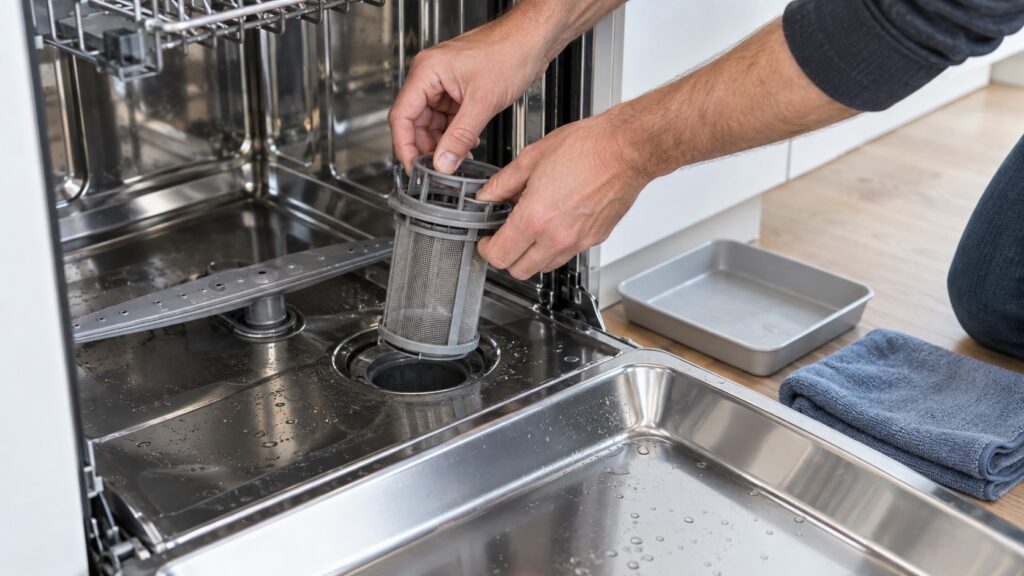
- Clean the filter. On a dishwasher that means lifting out the triple filter and rinsing it; on a washer it means opening the drain filter flap with a towel and a shallow tray ready.
- Look at the hose run. A drain hose kinked behind the machine, a blocked air gap, or a disposer knockout plug left in place produces a drainage code on a machine that is working perfectly.
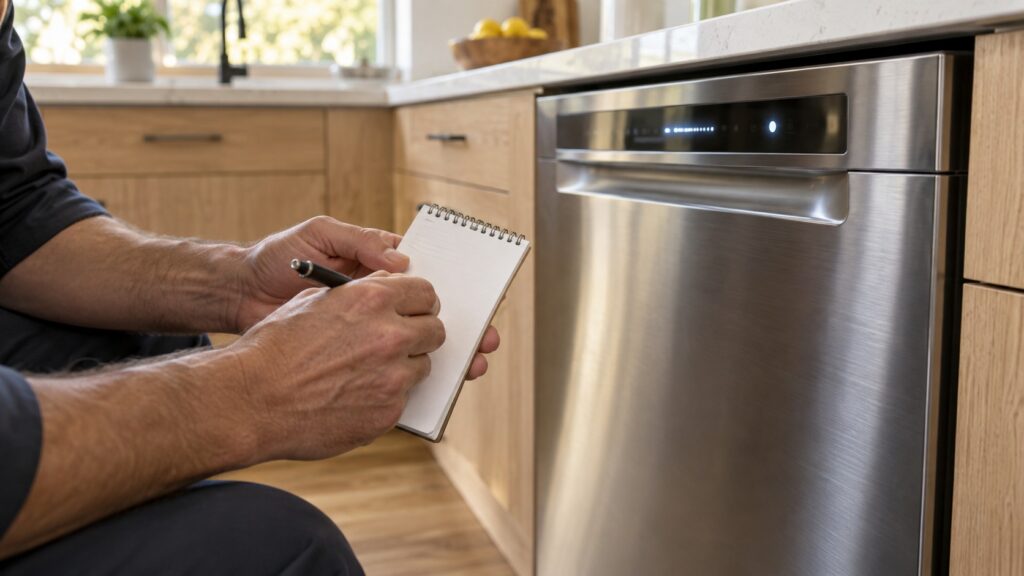
- Write down the exact display text. The number plus the phrase plus the appliance is what a technician needs. The number alone is the least useful of the three.
Stop before anything that involves opening the cabinet, the door lock assembly or the pump housing. Those parts sit close to mains wiring and to the water circuit, and on a sealed Miele cabinet they are not designed for casual access.
What the number cannot tell you
Two more limits are worth knowing before you spend an evening on a diagnosis. First, a code records the condition the machine detected, not the reason for it. A drainage code raised by a sock in the pump and a drainage code raised by a failing pump motor are the same number. Second, several Miele appliances latch the first fault they see and keep showing it even after a later, unrelated problem appears. If a machine has been left with a code on the display for weeks, the code may describe something that was fixed long ago.
Both limits point the same way: treat Miele error codes as a starting direction, confirm with what the machine is actually doing, and only then decide whether a part is involved.
When the code keeps coming back
A fault that returns after a filter clean and a power cycle is telling you the component itself has drifted, not that something was blocked. Speed-sensor codes in particular tend to appear intermittently for weeks before the part fails outright. That is the point to book service rather than repeat the same checks.
Our technicians carry the Miele-specific diagnostics for both the washer and dishwasher families, so the appliance is identified before any part is ordered. We are an independent repair company, not a factory service arm, and we will tell you when a repair is not worth doing. Pricing starts from a diagnostic visit and we confirm the estimate before any work begins.
If the machine is out of action, Miele washer repair and Miele dishwasher repair both cover the water group described above. You can schedule a visit with the code and the display message to hand, and read our Miele washer tips for the habits that keep drainage codes from coming back.