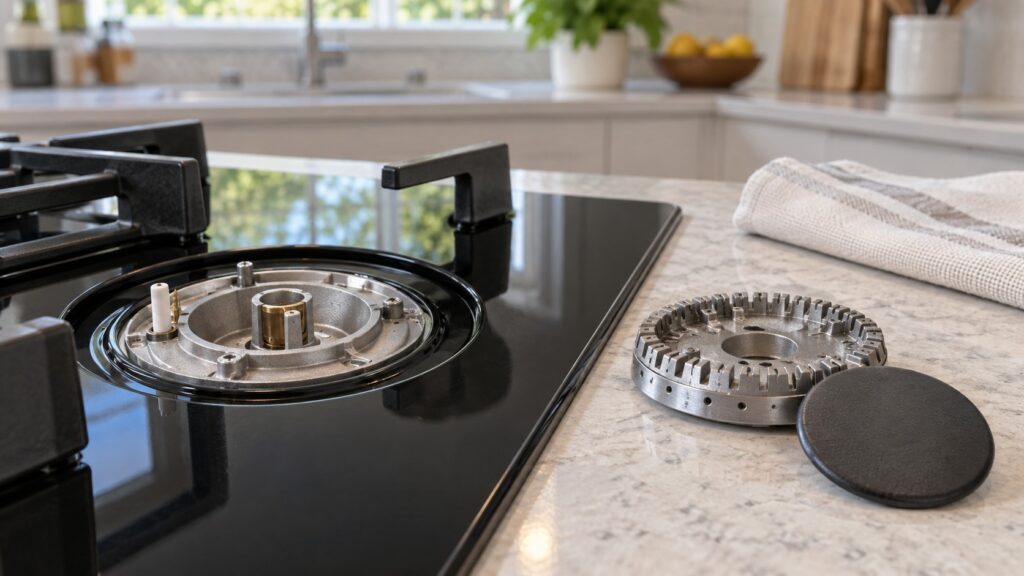
A Miele cooktop is built to be used hard and cleaned often, and most of the service calls we take on them trace back to habits rather than faults. Gas burners that will not light, induction zones that cut out mid-boil, and control panels that stop responding usually have a cause you can remove yourself. These Miele cooktop tips cover the handful of things that keep a gas or induction top working the way it did on day one.
Gas burners: keep the crown dry and the slots open
The M Pro sealed burners on a Miele gas top light from a spark electrode that sits beside the crown. Two things stop that working, and both are user-fixable. The first is a burner crown refitted while still damp after cleaning — the spark tracks across the moisture instead of jumping to the gas. The second is a slot blocked by a boil-over, which leaves one side of the crown starved so the flame lights and then dies.
If a burner clicks but will not light, take the cap and crown off, look along the slots against the light, clear them with a pin rather than a knife, and let both parts dry completely before refitting. Seat the crown so it drops flat with no rocking. If clicking continues across several burners at once, that is the shared spark module rather than a single burner, and it is not a cleaning job — our page on a Miele gas cooktop that will not ignite covers where the line is.
Induction: the pan is usually the problem
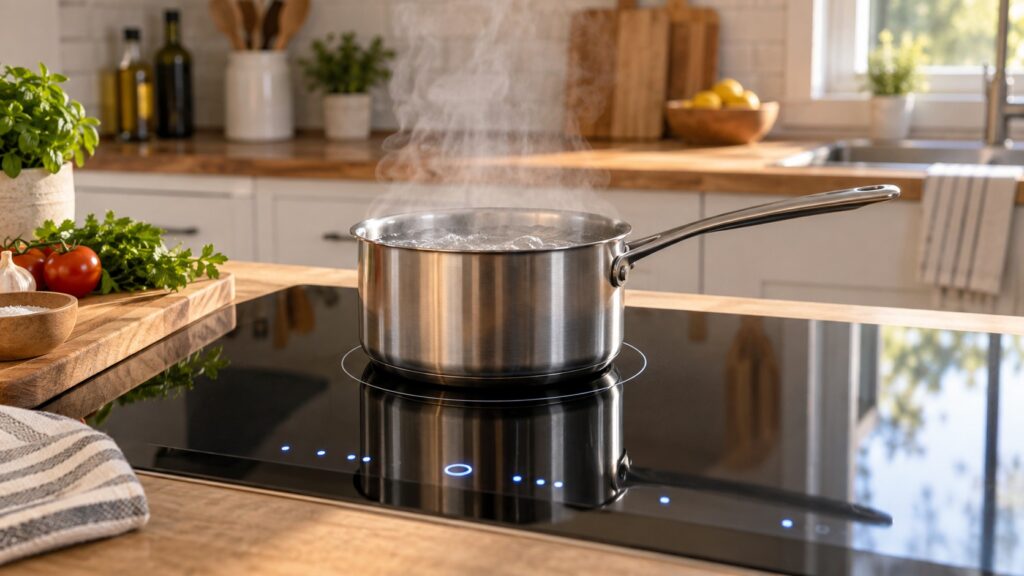
An induction zone heats the pan, not the glass, so anything that breaks the magnetic coupling reads as a fault. A base that has warped into a slight dome touches the glass only at the rim and heats slowly or cuts out. A pan smaller than the zone may not be detected at all. Aluminum and copper without a steel disc will never work, whatever the price of the pan.
- Test with a magnet. If a fridge magnet does not grip firmly across the whole base, that pan will not drive the zone reliably.
- Match the zone. Use the zone sized for the pan. On a PowerFlex area two zones bridge into one, which is what lets a long griddle work.
- Do not slide cast iron. Lift it. Sliding is the most common way the glass gets scratched, and scratches are cosmetic damage that no repair reverses.
- Listen for the fan. Induction electronics sit under the glass and are cooled by a fan that may run on after you switch off. That is normal, not a fault.
Cleaning without damaging the surface
Miele sells a ceramic cleaner for a reason: general kitchen sprays leave a film that bakes brown the next time the zone gets hot. The method that works is boring and repeatable. Let the surface cool to warm. Put a few drops of ceramic cleaner on the mark. Work it with a soft cloth. For anything hardened, use the scraper blade held almost flat and push, never dig. Finish with a dry cloth so nothing is left to bake on.
On gas, the caps and crowns can go in warm soapy water. The igniter electrode should only be wiped with a dry cloth — it is a ceramic tip with a thin wire and it breaks easily. Nothing on a Miele cooktop wants oven cleaner, and nothing wants an abrasive pad.
Heat that does not match the setting
A zone that runs hotter or cooler than the dial suggests is usually being asked to do something the pan cannot support. On gas, a flame that lifts off the crown and roars is a sign the burner cap is seated crooked; a lazy yellow flame that leaves soot on the pan means the air slots are partly blocked. Both are cleaning jobs, and both are worth fixing quickly because soot on a pan base becomes soot in the burner.
On induction, the two things that disguise themselves as weak heat are a pan that covers less than about two thirds of the zone and the top’s own protection stepping in. Induction electronics cut power when they get hot — after a long high-power boil, or when the vents under the counter are blocked by stored packaging. If a zone drops its power after ten or fifteen minutes and recovers once it has cooled, that is protection working, not a fault developing.
Controls that stop responding
Miele touch controls read a finger through a thin film of glass. They stop working when that film is wet, greasy or covered, and the behavior looks alarming: the panel lights but nothing responds, or a zone will not switch off. Dry the panel fully with a clean cloth and try again before assuming a fault. A spill bridging two keys can also lock the panel deliberately — that is the safety design working.
If the panel is dry and clean and still unresponsive, or if a flashing symbol appears, the control board is reporting something. Our guide on a Miele induction cooktop that will not heat goes through what the display is saying and which of it you can clear.
What is worth a service visit
Stop at anything that involves lifting the cooktop out of the counter, touching the gas connection, or opening the underside of an induction top. Those parts sit against mains wiring and, on gas, against a live supply line. The honest list of jobs that need a technician is short: a spark module that clicks on every burner, a zone that has failed while its neighbours work, a cracked glass surface, and any smell of gas at all.
We are an independent repair company, not a factory service arm, and we will say when a cooktop is not worth repairing. Pricing starts from a diagnostic visit, and we confirm the estimate before any work begins. If you have reached the end of this list, Miele cooktop repair covers both gas and induction tops, and you can schedule a visit online. For the deeper clean that gas burners need twice a year, follow our burner cleaning guide, and the M Pro burner explainer covers what the two-stack design is doing.