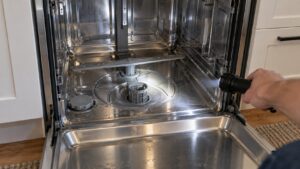
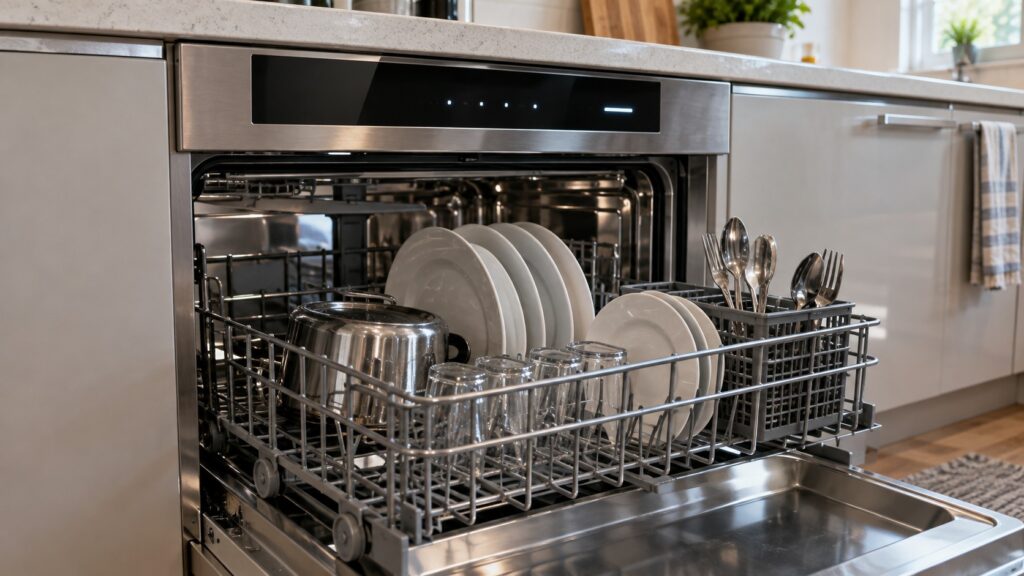
A Miele dishwasher F13 means the machine did not get the water it expected at the end of a fill step. The control electronics open the inlet valve, watch the flow meter count the fill, and stop the step when the count is reached. When that count never arrives, the cycle halts and F13 appears. It is a water-intake fault, not a drain fault and not a leak, and the four codes around it split the same problem into narrower pieces.
That distinction is what saves the evening. Miele gives the intake circuit five separate numbers, and each one points at a different place in the run between the house shutoff valve and the tub.
What does F13 mean on a Miele dishwasher?
Read the code as a timing statement. A Miele dishwasher F13 says water started moving and then stopped short of the volume the program called for, inside the time the control allows. Two ordinary conditions produce exactly that: the supply lost pressure part way through, or something restricted the path once the valve was already open. Neither of them is a failed circuit board, which is why F13 is one of the most rewarding Miele codes to work on yourself.
The difference between F12 and F13 is worth holding on to. F12 appears when nothing arrives at all, which usually means the shutoff valve is closed, the hose is crimped, or the inlet valve is not opening. F13 means the machine got some water. Something upstream is throttling the supply rather than blocking it.
Why does a Miele dishwasher stop filling part way through?
The restriction is almost always mechanical and almost always upstream of the tub. In order of how often we find them:
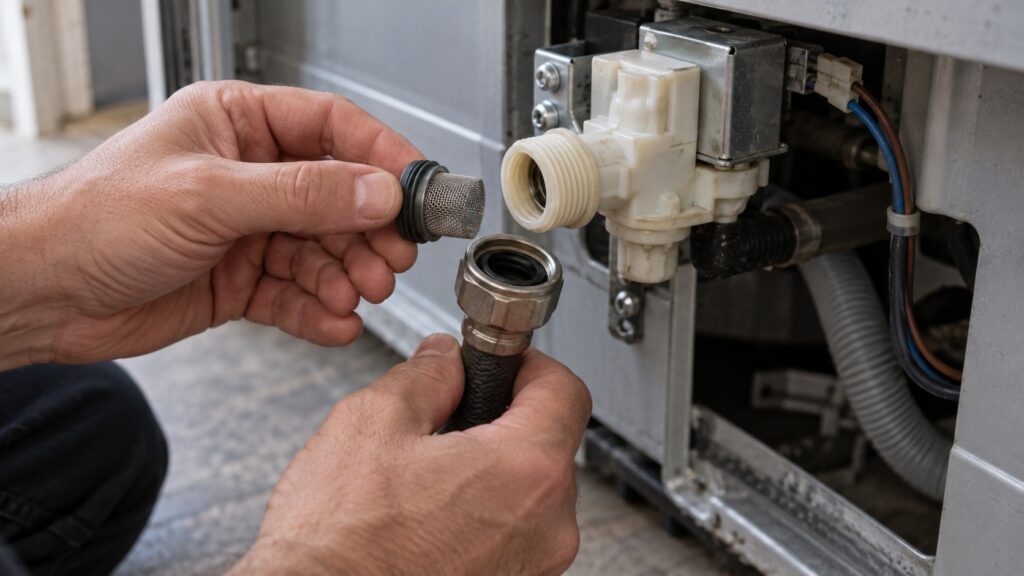
- The inlet screen. Miele puts a fine mesh filter in the hose coupling at the supply end. Grit from municipal work, or scale flaking off an older water heater, collects there and cuts the flow rate without stopping it.
- A partly closed shutoff valve. A valve under the sink that has been turned most of the way back after other work passes water, just not fast enough.
- A crimped or crushed inlet hose. Pushing the machine back into its opening after service pinches the hose against the rear wall.
- Low house pressure at certain hours. Machines that raise F13 only in the morning, or only when irrigation is running, are reporting the building, not themselves.
- A weakening inlet valve. The solenoid opens but no longer opens fully, usually after years on hard water.
How are the flow meter codes F18 and F19 different?
The flow meter is a small paddle wheel in the intake path, and the control counts its turns to measure the fill. F18 means the wheel is not turning at all; F19 means it turns, but stiffly enough that the count cannot be trusted. Both codes are about measurement rather than supply, and that is the practical difference: with F18 or F19 the water may well be arriving normally while the machine insists it is not.
The two codes matter for another reason. If you chase a Miele dishwasher F13 by cleaning screens and checking pressure, and the machine then starts showing F18 or F19 instead, the fault has moved from the supply to the meter. That is progress, not a new problem, and it tells a technician exactly which part to bring. Full detail for each number sits on the code pages themselves: F13, F12, F18 and F19.
What can you safely check before calling anyone?
Work from the house end toward the machine. Everything in this list stays outside the cabinet.
- Open the shutoff valve fully. Turn it counterclockwise until it stops, then back a quarter turn. Run the faucet next to it and watch the stream: a hot faucet that fills a quart jar in under five seconds is giving the dishwasher what it needs.
- Look behind the machine. Pull it forward only as far as the hoses allow and check that the inlet hose is not pinched, kinked or looped tightly against the wall.
- Clean the inlet screen. Close the shutoff valve, unthread the hose at the supply end with a towel underneath, and rinse the mesh insert. It is the single most common find behind this code.
- Cut power for two minutes. Miele latches many faults. If F13 returns on the next cycle, the machine is reporting a live condition rather than a stored one.
- Note when it happens. Same point in every cycle, or random? Only during peak household water use? Write it down; it shortens the diagnosis considerably.
Stop there. The inlet valve, the water-path components under the base and the wiring that runs beside them sit inside the sealed cabinet, close to both mains voltage and the water circuit. Miele builds those machines to be opened by someone with the service documents, and an intake fault is never urgent enough to justify improvising.
Does a reset clear a Miele dishwasher F13?
A reset clears the display, not the cause. Holding the start button or cutting power at the breaker drops the stored fault, and the machine will happily begin another cycle. If the restriction is still there, the same code returns at the same step. Treat a reset as a test rather than a repair: a code that stays away for a week after a screen clean was a screen problem, and a code that returns on the very next load never was.
One more habit is worth building. If your water is hard, the same scale that clogs inlet screens is also building up inside the machine, and the softener has a part to play. Our guide to the Miele dishwasher water softener explains how the salt reservoir works and why a machine set for the wrong hardness quietly fouls the intake path.
When is it the valve, and when is it the house?
The clean test is comparison. Fill a quart container from the hot faucet nearest the dishwasher and time it. If that takes noticeably longer than it used to, or than another faucet in the house, the supply is the suspect and the machine is innocent. If the faucet is strong and the screens are clean, the inlet valve or the flow meter is the remaining candidate, and both are parts replacements rather than adjustments.
A technician confirms this with a fill test: the machine is asked to fill while the actual volume and the meter count are watched together. That takes minutes, and it is the difference between replacing a valve that was fine and replacing one that had genuinely drifted.
We are an independent repair company, not a factory service arm, and we will tell you when a repair is not worth doing. Pricing starts from a diagnostic visit, from $89 in most of our service area, and we confirm the estimate before any work begins.
If the code keeps coming back, Miele dishwasher repair covers the whole intake path, and you can schedule a visit with the code and the step it stops at written down. For the faults that look similar but are not, see F11 and drainage, which is the same water circuit running the other way, and why the same Miele number means different things on different machines.