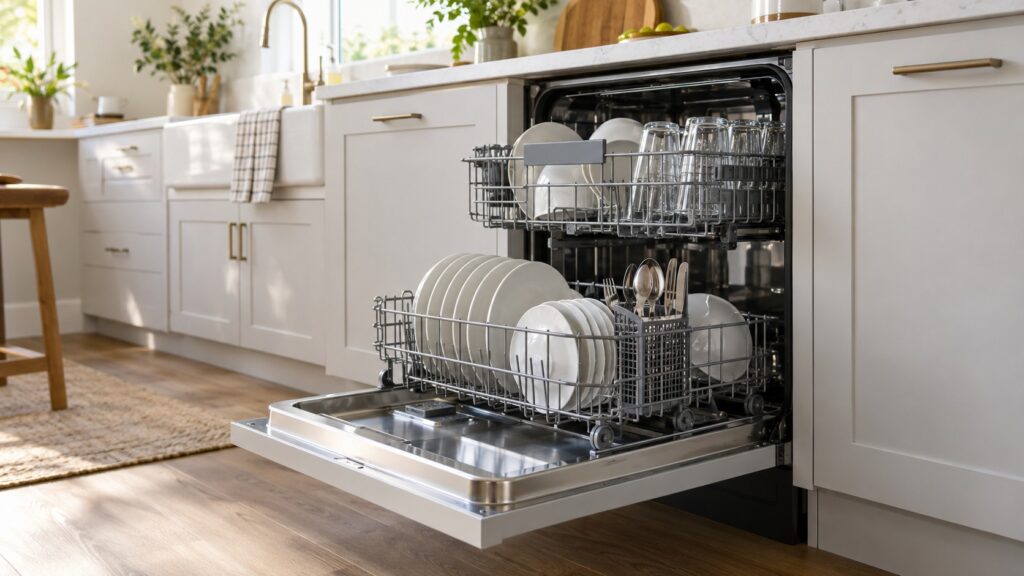
Good Miele dishwasher loading comes down to letting water and detergent reach every dirty surface. That means facing dirty sides toward the spray, leaving gaps so items do not nest or touch, keeping tall items from blocking the spray arms and using the adjustable parts of the racks. Our model pages list the G-series dishwashers with a 3D MultiFlex tray and FlexLine adjustable baskets, and our dishwasher tips guide says to load so that nothing blocks the spray arms. Your owner’s manual shows the layouts and weight limits for your model.
How should you load plates and bowls?
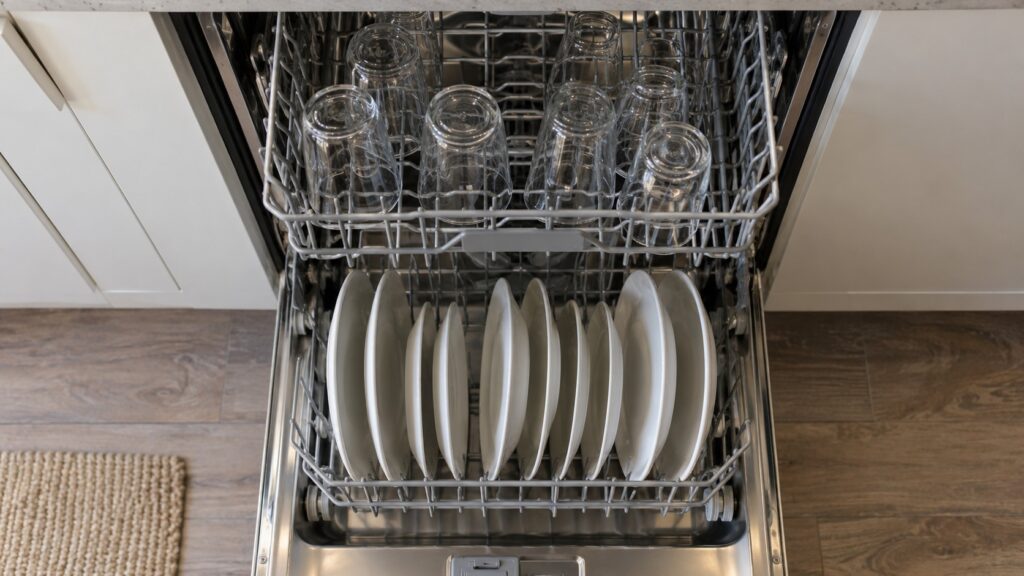
Put plates in the lower basket with the dirty side facing the center and slightly down, and leave a little space between each one so the spray reaches both faces. Bowls go in angled so that water runs out rather than collects. Keep large platters and cutting boards at the sides or back of the basket, where they do not block the spray from the center.
Do not lean items against each other. Stacked bowls and plates form a tight seal where they touch, and the water cannot reach that surface. If the load will not fit without nesting, run two loads rather than one crowded one. A crowded dishwasher uses the same water and gives a worse result.
What goes in the upper basket?
Glasses, cups, small bowls and plastic items that are dishwasher-safe, as the labels say. Place cups and glasses upside down at an angle between the prongs so that they do not sit flat, which would let water collect in the base. Keep glasses from touching each other, because they can chip and the contact spots stay wet. Light plastic can be pushed around by the spray, so place it where it cannot flip over and collect water or block an arm.
Our model pages describe FlexLine adjustable baskets on the G-series dishwashers, meaning parts of the basket can be adjusted to fit tall or awkward items. How the adjustment works on your model is in the manual. Do not force a basket height or a rack that does not move easily.
Where do utensils and knives go?
On the models that list a 3D MultiFlex tray, your owner’s manual shows what the tray is meant to hold; if it takes cutlery or small utensils, spread them out so that they do not nest. Our spec sheets only name the tray. If your dishwasher has a cutlery basket instead, mix the handles up and down so that spoons do not lock together. Put sharp knives with their points down in a basket or flat in a tray, never sticking up where a hand can reach, and do not let them rest against delicate items.
What should you keep out of the dishwasher?
Anything the maker says not to wash in a machine. Wooden items, cast iron, non-stick pans that say hand wash only, fine crystal and items with glued handles are the usual examples, but the label on each item is the authority. Check your owner’s manual for materials that are not recommended. Do not put in items that could melt or warp, such as plastic that is not marked dishwasher-safe.
How do spray arms and filters affect the load?
Every arm has to turn freely. After loading, spin each arm by hand and check that no handle, pan or tall glass catches it. Our dishwasher tips guide says to load so nothing blocks the spray arms, and also says to clean the triple filter regularly. Scrape off large pieces of food, check your manual for what it says about pre-rinsing and do not run the machine with the filter missing. Our Miele dishwasher filter cleaning guide shows how to do it, and the dishwasher not cleaning guide helps if dishes are still dirty.
Detergent and rinse aid are part of the result. Models with AutoDos dose the detergent for you, as our AutoDos and PowerDisk guide explains, and others need a tablet each cycle. Keep the softener salt and rinse aid topped up, as our tips guide advises.
What about drying and unloading?
Our AutoOpen drying guide says that AutoOpen opens the door a few inches at the end of the cycle so that humid air escapes, and that pushing the door shut cuts the drying short. If your model uses it, leave the door as it opens. Unload the lower basket first so water on the upper items does not drip onto dry plates. Let items cool before you handle them if the manual says they will be hot.
When does the problem go beyond loading?
If dishes are dirty even with a good load, the dishwasher leaves water on the floor, an F code shows or the door will not close, loading is not the cause. See our guides on a dishwasher that will not start and on water on the floor. Do not take panels off. If water reaches an outlet or the cord, switch off the breaker at the panel while standing on a dry floor, and do not pull the plug from a wet outlet. We are an independent repair company, not the manufacturer. Our Miele dishwasher repair page explains how a visit works, and you can book a visit online.