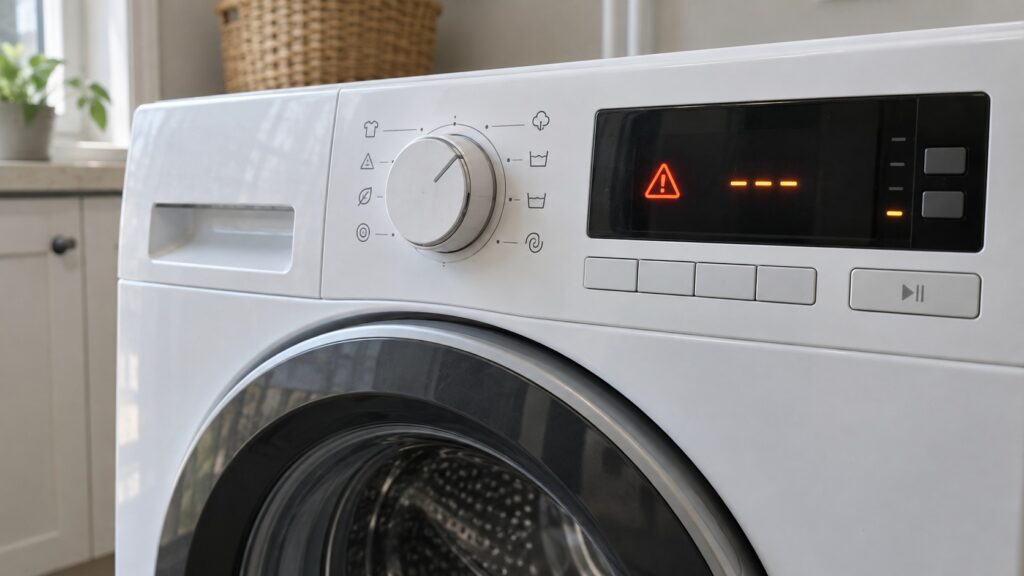
An F62 Miele washing machine fault is a program-selector problem. The machine cannot read the selection you made, or cannot agree with itself about which program is running, so it refuses to start or stops the moment it tries. Nothing about F62 concerns the drum, the pump, the heater or the door lock, which is why the usual laundry-room checks find nothing at all.
This is one of the few Miele codes where the fault sits on the user side of the machine rather than in the water circuit. The selector, the display board and the main control talk to each other constantly. When the answers stop matching, the control stops the cycle instead of guessing which wash you wanted.
What does F62 mean on a Miele washing machine?
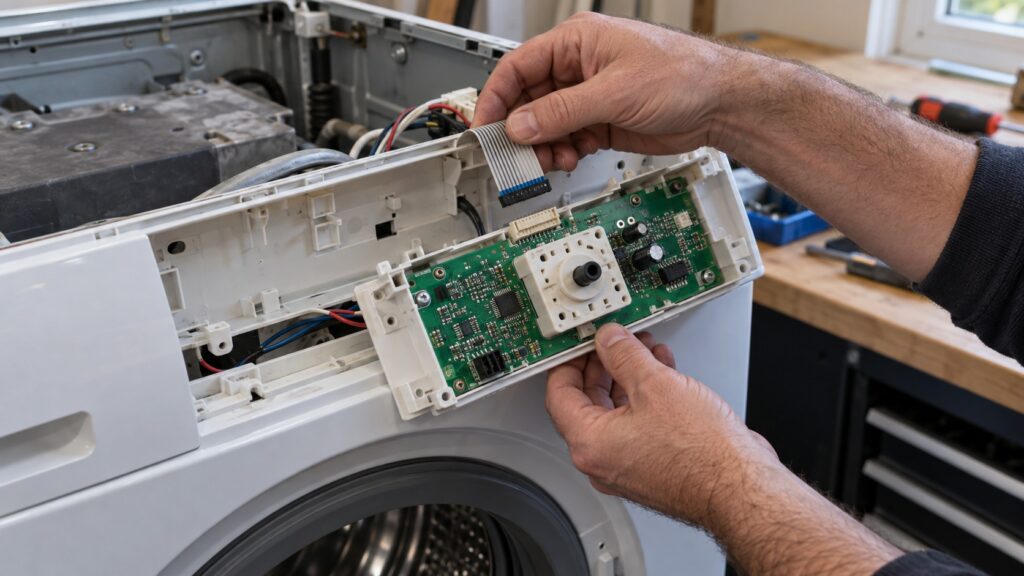
The selector on a W1 is not a mechanical switch that closes a contact and lights a lamp. It is an encoder read by the electronics, and the position you turn it to is a number the board has to interpret. F62 is raised when that number is missing, contradictory, or changing when the knob is not moving.
Three conditions produce it. The encoder or its ribbon connector has lost contact, usually after years of vibration. Moisture or detergent residue has crept behind the panel and is bridging contacts. Or the board reading the encoder has itself drifted. From outside the machine these look identical: you turn the dial, the display either does not follow or jumps, and the cycle will not begin.
Why does an F62 come and go?
Intermittent behavior is the signature of a connection rather than a component. A ribbon that has worked loose makes contact at rest and breaks it when the drum spins up and the cabinet flexes. That is why so many owners describe the same sequence: the machine works first thing in the morning, throws an F62 on the second load of the day, then works again after sitting overnight.
Heat plays a part too. A control cabinet that warms up over several back-to-back loads expands slightly, and a marginal connection that holds when cold opens when warm. If your F62 appears only on the second or third load, mention that when you book service. It points at connections instead of parts, and it is the sort of detail nobody can recover from the machine afterward.
What else shows up alongside it?
F62 rarely arrives alone on a machine that is genuinely failing. F39 is the broader electronics fault, F100 says two boards have stopped communicating cleanly, and F104 reports low drive voltage, which is a different subsystem altogether and usually a supply or motor-drive matter. If you have seen two of these numbers in the same week, the machine is telling you about the control side as a whole rather than about a single encoder.
Per-number detail lives on the code pages: F62, F39, F100 and F104. Note the contrast with the water-side codes: an F11 drainage fault has a filter you can open and a hose you can look at, while a selector fault has neither.
What can you try before calling anyone?
The safe list is short, because everything else is behind the control panel.
- Cut power at the breaker for five minutes. Not thirty seconds. The control boards hold a charge, and a genuine restart needs the capacitors to drain. A latched F62 that clears and does not come back for a week was a latched fault, not a failing part.
- Turn the selector slowly through every position, twice. Watch whether the display follows each step. A dial that skips a position or shows a program you did not select has told you the encoder is the suspect.
- Check the outlet, not just the machine. A W1 sharing a circuit with something heavy can see voltage dips that read as control faults. Try the machine when nothing else on the circuit is running.
- Dry the panel area. If something was spilled across the top of the machine or steam has been venting from a dryer stacked above it, leave the machine off for a day with the door open before drawing conclusions.
- Write down the exact sequence. Which program, how far into it, what the display said. Three data points beat an afternoon of testing.
Stop before removing the top panel or the detergent drawer housing to reach the electronics. Those boards carry mains voltage, they sit directly above the drum and the water valves, and the ribbon connectors are easy to damage permanently with a fingernail.
Is the selector repairable, or does the board have to be replaced?
Often it is repairable. A reseated connector or a cleaned encoder costs a service visit and no parts at all, and that is the outcome in a meaningful share of the F62 calls we take. When the encoder itself has worn, it is a separate part from the main control on most W1 machines, so the repair stays modest. The expensive path — replacing the main control — belongs to machines showing F39 or F100 as well, where the problem is the board and not what is plugged into it.
This is also where the age of the machine matters. Miele W1 washers regularly run fifteen years or more, and a control repair on a ten-year-old machine that is mechanically sound is usually worth doing. Our repair or replace guide lays out the numbers, and the W1 buying guide explains what differs between the models if the answer turns out to be replacement.
When should you stop and book service?
Book it when the code survives a full power-down, when the display no longer follows the dial, or when a second control code has joined it. Those three signs mean the machine has moved past the point where anything you can reach will help.
We are an independent repair company, not a factory service arm, and we will tell you when a repair is not worth doing. Pricing starts from a diagnostic visit, from $89 in most of our service area, and we confirm the estimate before any work begins.
Miele washer repair covers the control side as well as the water side, and you can schedule a visit with the model number from the door frame and the pattern of when the code appears. If you want to keep the rest of the machine out of trouble meanwhile, our washer tips and the descaling guide cover the habits that matter most.