Miele oven F05, F06, F07 and F09 are four separate fault codes, and they are not four random numbers — they are two sensors crossed with two failure modes. A Miele wall oven has a main temperature sensor that watches the cavity and a second sensor that watches the catalytic/self-clean side, and each of those two sensors can fail two different ways: shorted, or open-circuit. Line them up and the four codes stop looking arbitrary.
What does Miele oven code F05 mean?
Miele oven F05 means the main cavity temperature sensor has developed a short circuit. That sensor is the one the control board reads continuously to decide how much power to send the heating elements, so a short on its wiring tells the board the temperature is doing something impossible — and the board stops the bake rather than guess. F05 is specifically a wiring or sensor-element short, not a general “oven too hot” alarm, which is why the fix is electrical rather than mechanical.
In practice F05 shows up mid-cycle, sometimes after the oven has been running hot for a while, sometimes on a cold start. Either pattern is consistent with a short: a strained wire pinched behind the liner, insulation that has worn through where the harness passes near the cavity wall, or the sensor itself failing internally.
What does Miele oven code F06 mean?
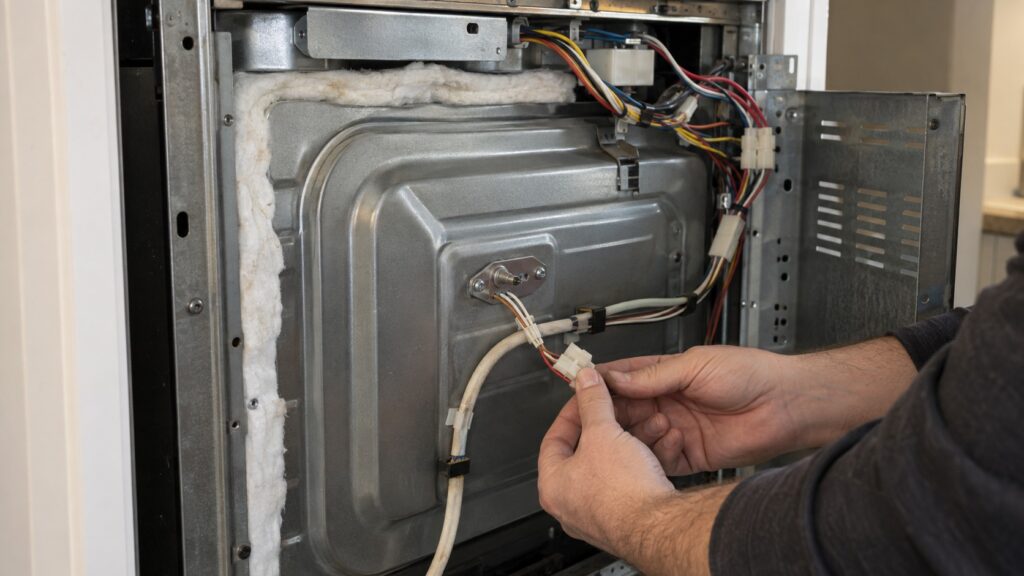
Miele oven F06 is the same sensor’s opposite failure: an open circuit rather than a short. The board sends a small signal down the sensor line and expects a reading back; F06 means nothing is coming back at all, as if the wire had been cut. A connector that has worked itself loose behind the back panel, a broken wire in a harness that flexes every time the door is opened, or a sensor that has failed open internally will all raise F06.
F05 and F06 point at the identical physical sensor and the identical wiring run — the difference is only which direction the fault failed in. That matters for a technician because the diagnostic steps (continuity check, connector inspection, resistance reading against the sensor’s rated curve) are the same regardless of which of the two codes is showing.
What does Miele oven code F07 mean?
Miele oven F07 is a short circuit, but on the second sensor — the one that monitors the catalytic or self-clean side of the cavity rather than the main bake temperature. Not every reader will immediately place this sensor, because it does less day-to-day work than the main one; it exists mainly to watch conditions during self-clean cycles and certain high-heat functions, where a second, independent temperature reading is a safety measure.
Because F07 involves a different sensor and a different wiring run than F05, a repair aimed at the main cavity sensor will not touch F07 at all. That is the single most common wrong turn with this family of codes: assuming “F-something” always means the same part.
What does Miele oven code F09 mean?
Miele oven F09 is the catalyst/cavity sensor’s open-circuit counterpart to F07 — same second sensor, opposite failure direction, exactly as F06 relates to F05. If a self-clean cycle will not start, or ends early with a fault, F09 or F07 is a more likely cause than a problem with the main bake sensor, because self-clean is precisely where the second sensor is doing its job.
Why isn’t the letter F alone enough to diagnose a Miele oven fault?
Miele’s own fault-code scheme packs two independent pieces of information into the last two digits of a code, and F05/F06/F07/F09 is as clean a demonstration of that as exists on the whole appliance line: one digit-pair tells you which sensor, and the failure direction tells you which way it failed. Reading only the letter F, or assuming any flashing F code means “the oven is broken,” throws away both pieces of information and leaves you guessing between two sensors and two very different repairs.
This is the same limitation covered more generally in our guide to a flashing F code and how to reset it, and it is worth reading alongside this one: that guide covers the reset procedure itself, while this one covers what the specific number is actually telling you before you reset anything.
Can I fix a Miele oven sensor code myself?
There is a safe first step regardless of which of the four codes is showing: cut power to the oven at the breaker for a couple of minutes and restart it. Sensor faults are sometimes reported once from a momentary glitch — a brief power fluctuation, a connector that shifted slightly — and clear on restart. If the code returns immediately, the board is reading a live condition, not a stored one, and a power cycle will not fix it.
Beyond that, stop. Both sensors and their wiring sit inside the oven’s back panel, close to the heating elements and the cavity liner, and reaching them means removing panels around a 240-volt appliance. That is a job for a technician with the multimeter and the sensor’s rated resistance curve on hand, not a kitchen repair.
When does a Miele oven sensor code mean the whole sensor needs replacing?
A short or open reported once and cleared by a power cycle may simply have been a momentary connector issue. A code that returns within a day or two, especially if it returns at the same point in a bake cycle every time, usually means the sensor element or its wiring has genuinely failed rather than glitched, and a replacement sensor — not just a reseated connector — is the fix. Worth noting: a worn or gapped oven door seal lets heat escape unevenly and can make a marginal sensor look worse than it is, so a technician diagnosing F05/F06 will usually check the door seal along the way.
If your Miele oven is showing any of these four codes, a Miele oven that is not heating at all is a related symptom worth ruling out first, since a sensor fault and a heating-element fault can look similar from the kitchen side. Our technicians carry the diagnostics to tell the two sensors and both failure directions apart before any part is ordered, and we confirm the estimate before work begins. Miele oven repair covers both sensor families, and you can schedule a visit with the exact code and display message to hand.