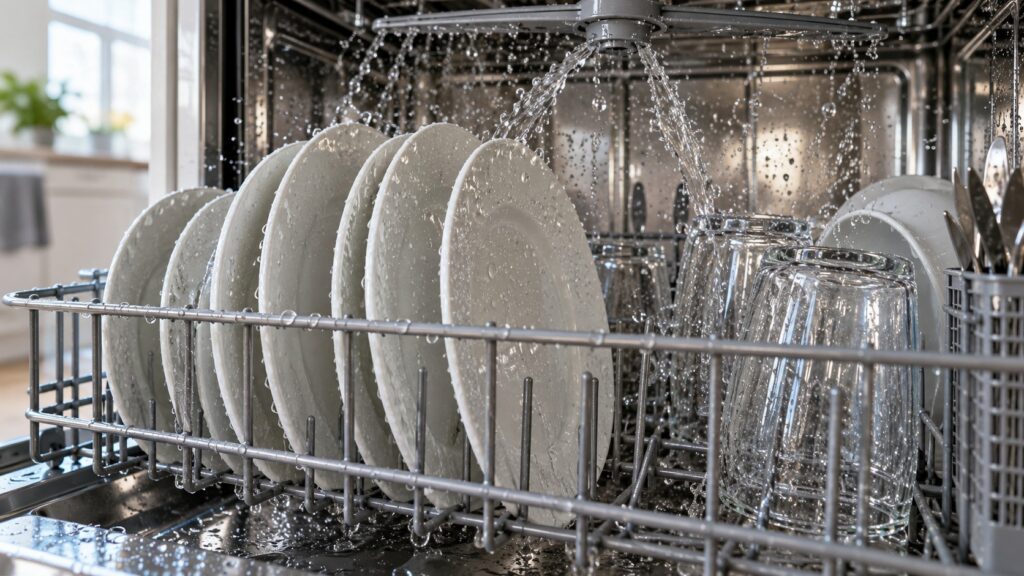
Miele QuickPowerWash is a short dishwasher program that finishes a load in roughly an hour by washing hotter and with stronger spray than a gentle program would, so the same cleaning happens in less time. It is built for everyday plates, glasses and cutlery that are normally or lightly soiled, not for pots with baked-on food. Think of it as the program you reach for when the dishes are needed tonight, and the normal program as the one you use when they are not.
What is Miele QuickPowerWash?
QuickPowerWash is the name Miele gives to a quick program on its dishwashers. Where the normal program may take two hours or more, with a long, patient sequence of fills, soaks and rinses, QuickPowerWash compresses that into about an hour. It does so by working harder rather than by skipping steps: the water is hotter, the spray is more forceful, and the phases are tightly timed so the dishes are washed, rinsed and given a short drying phase in a single hour.
The exact times and program names differ across models and years, so treat the one-hour figure as a guide and check your manual for the number on your machine. What does not change is the idea behind it: a short program that trades time for intensity. Our guide to Miele G7000 vs G5000 dishwashers shows how the program lists differ between the series.
How does a dishwasher wash in an hour?
A dishwasher cleans through four things: heat, water movement, detergent and time. A long program leans on time, letting detergent soften soil gently at a lower temperature. A short program has less time, so it raises the other three. The water is heated higher so that fats dissolve faster. The spray arms run harder so that the water strikes the dishes with more force. The detergent is released early so that it works from the start of the cycle.
In a Miele, the dosing of detergent matters too. Models with automatic dosing release the right amount at the right moment, which suits a short program because there is no time to waste. Our guide to how Miele AutoDos and PowerDisk work explains the dosing system. The result is that a short program can match a longer one on ordinary soil, though not on heavy soil.
What loads suit QuickPowerWash?
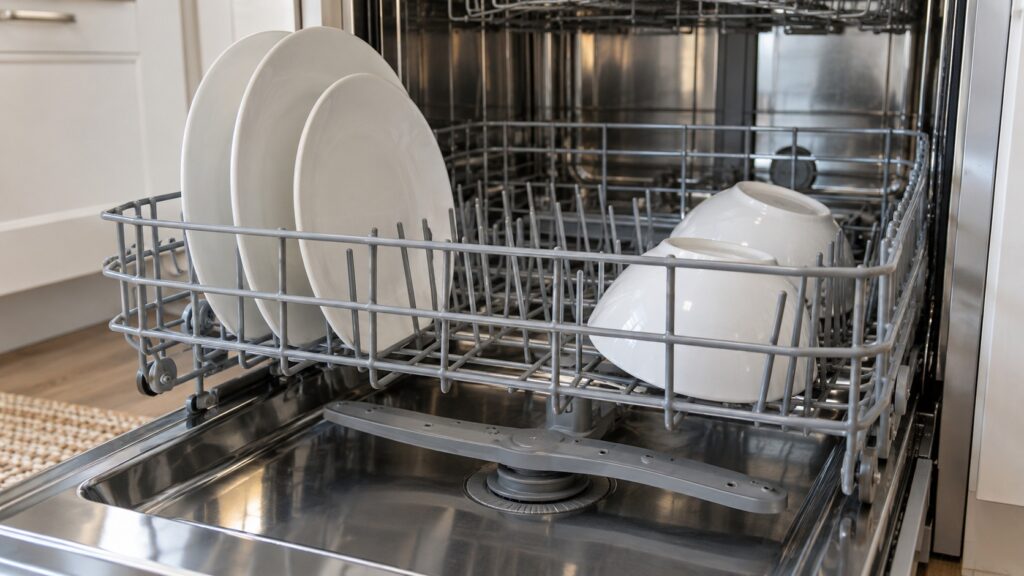
It suits the dishes most households use daily: plates, bowls, glasses, mugs and cutlery that have been scraped and are not caked. A dinner for four after a normal meal is a good example. It is also useful for a half load of glasses before guests arrive, or a quick rerun when you need a specific item. It handles light soil easily and normal soil well.
It is a poor choice for heavy pans, baking trays with burned-on residue, dried egg or starch, and anything that has sat for a day. Those loads need the time and the soak of a longer program, and running a quick one often leaves marks that then need hand washing, which defeats the point. If you are unsure, look at the dishes: if a fingernail would scrape off the residue, use the longer program.
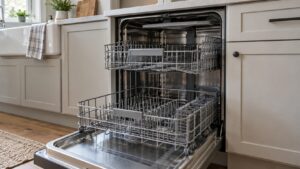
A few habits make the short program work better. Scrape food off, but do not rinse dishes under the tap, because the detergent needs some soil to work against and a pre-rinse wastes water. Load the heaviest items in the lower rack with the dirty side toward the center, and avoid nesting bowls, which hides surfaces from the spray. Fill the salt and rinse aid when the display asks, because a short program has little time to make up for soft water that is not soft enough or dishes that do not drain cleanly.
How does drying work after a short program?
Drying is the area where short programs compromise. A Miele dries by letting the hot final rinse warm the dishes and by condensation on the cooler tub walls, and on many models the door is opened slightly at the end to let steam escape. A short program has a short drying phase, so glass and china usually come out fine, but plastic and the bottoms of cups may stay damp. That is normal, not a fault.
Help the drying along by keeping rinse aid topped up, by loading plastic on the upper rack and tilted, and by leaving the door ajar after the cycle if your model does not do it itself. Our Miele AutoOpen drying guide explains the automatic door opening, and the Miele dishwasher not drying guide covers the cases where dishes stay wet in every program.
When does a quick program disappoint?
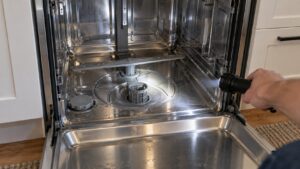
If dishes come out dirty after QuickPowerWash, the program may not be the cause. A clogged filter, blocked spray arm nozzles, a loading problem or a low detergent amount all show up more in a short program, because there is less time to compensate. Check the filter in the base of the tub and clean it, make sure the spray arms spin freely and that nothing blocks them, and do not overload the racks. Our Miele dishwasher filter cleaning guide shows the steps.
If everything is clean and the dishes still come out dirty in every program, see our Miele dishwasher not cleaning guide. A fault in the circulation pump, heater or spray system may be involved, and a technician can test each. Our Miele dishwasher tips offer everyday habits that make every program work better.