An F84 Miele dishwasher fault is a slide-shutter positioning problem: the valve that steers water between the spray levels is not where the control expects it to be. On a Miele the circulation pump does not feed every spray arm at once. A shutter inside the water-distribution system moves to select which level gets the pressure, and F84 means that movement was not confirmed.
That single mechanism explains a complaint we hear constantly and that no amount of detergent fixes: the lower rack comes out spotless and the upper rack comes out dirty, or the other way around, cycle after cycle.
What does the slide shutter actually do?
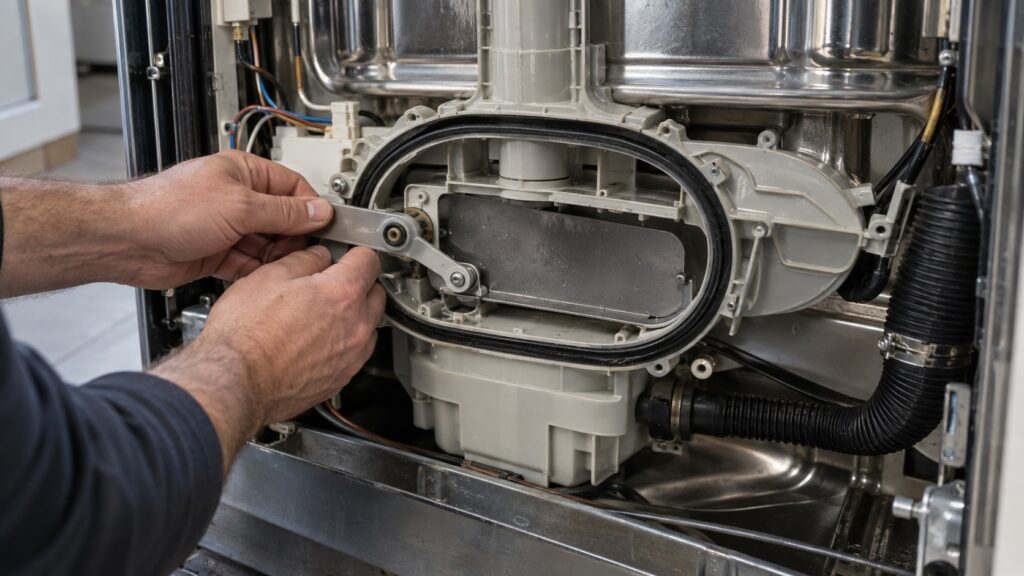
Think of it as a points switch on a rail line. The circulation pump produces one stream of pressurized water. The shutter decides where that stream goes: the lower arm, the upper arm, or on models with a third level, the spray bar above it. During a wash the control moves the shutter on a schedule, so each level gets a share of the full pump pressure in turn rather than every level getting a weak trickle at once.
That design is why a Miele washes as well as it does on modest water use. Concentrating the full flow on one level at a time produces real mechanical force at the dishes. The cost of the approach is a moving part in the water path, and a moving part in a machine that runs hot with detergent every day eventually collects deposits.
How do F84, F63 and F85 differ?
All three belong to the same assembly, and the distinction is about which half of the loop broke. F84 is a positioning problem: the shutter was asked to move and the move was not confirmed. F63 is the broader water-distribution fault for the same system. F85 concerns the signal — the position feedback the control reads — so the shutter may be moving perfectly while the machine cannot tell.
The individual code pages carry the per-number detail: F84, F63 and F85. Worth knowing before you read them: F63 means something different on a Miele washer, where it describes a water-path fault rather than a shutter, and that overlap has sent plenty of people to the wrong parts list. Our guide on Miele numbers that mean different things on different machines covers the other reused codes.
Why does only one rack come out clean?
Because a shutter that is stiff, partly obstructed or slow can still reach some positions and not others. The level it can reach keeps washing normally; the level it cannot reach receives little or no pressure for its whole allotted time. The dishes then sort themselves into two groups with a sharpness that looks like a loading problem but is not.
Two other patterns point the same way. Wash quality that changes with the program — good on a long intensive cycle, poor on a short one — suggests the shutter is slow rather than stuck, and a short program does not give it time. And a machine that washes well for the first few loads after a hot cleaning cycle and then drifts back is telling you about deposits.
What makes a slide shutter stick?
- Hard-water scale. The single biggest cause. A machine set to the wrong water hardness, or run without salt, builds deposits everywhere in the water path, and a close-fitting moving valve is where they matter first. Our guide on the Miele water softener and salt explains the setting.
- Detergent and grease residue from long runs of short, cool programs that never reach a temperature high enough to keep the water path clean.
- Debris that got past the filter — a fruit sticker, a shred of paper label, a fragment of eggshell.
- Wear in the drive after many years, which is the honest end of the list and the one that needs a part.
What can you check yourself?
You cannot see the shutter without dismantling the water-distribution system, so the useful checks are indirect.
- Check the spray arms turn freely. Spin each by hand. Resistance or a wobble is an arm problem and looks nothing like a shutter problem once you have compared the two.
- Clear the spray-arm jets. Blocked holes starve a level and mimic the same symptom exactly. A toothpick and a hot rinse are enough.
- Set the water hardness correctly and keep salt in the reservoir. On hard water this is preventive maintenance, not an optional extra.
- Run a hot cycle with a dishwasher cleaner and an empty machine. If wash quality improves for a week and then slides back, the deposits are real and they are inside the water path.
- Note which rack fails and on which program. That pair of facts is what identifies the position the shutter cannot reach.
Stop before opening the tub interior or removing the distribution housing. Those parts sit inside the sealed water circuit, alongside the heater and its mains wiring, and refitting them without the right seals turns a wash complaint into a leak.
Is a slide-shutter fault worth repairing?
On a machine that is otherwise healthy, yes. The assembly is serviceable, the repair does not involve the control board, and a shutter cleaned before it is worn often needs no part at all. Leaving it is the expensive choice: a shutter that is driven against a deposit for months takes its drive with it. The arithmetic for an older machine is in our repair or replace guide, and if the answer points at a new machine, the G7000 against G5000 comparison is the place to start.
We are an independent repair company, not a factory service arm, and we will tell you when a repair is not worth doing. Pricing starts from a diagnostic visit, from $89 in most of our service area, and we confirm the estimate before any work begins.
If one rack has been washing badly for weeks, Miele dishwasher repair covers the distribution system, and you can schedule a visit with the rack, the program and the code written down.