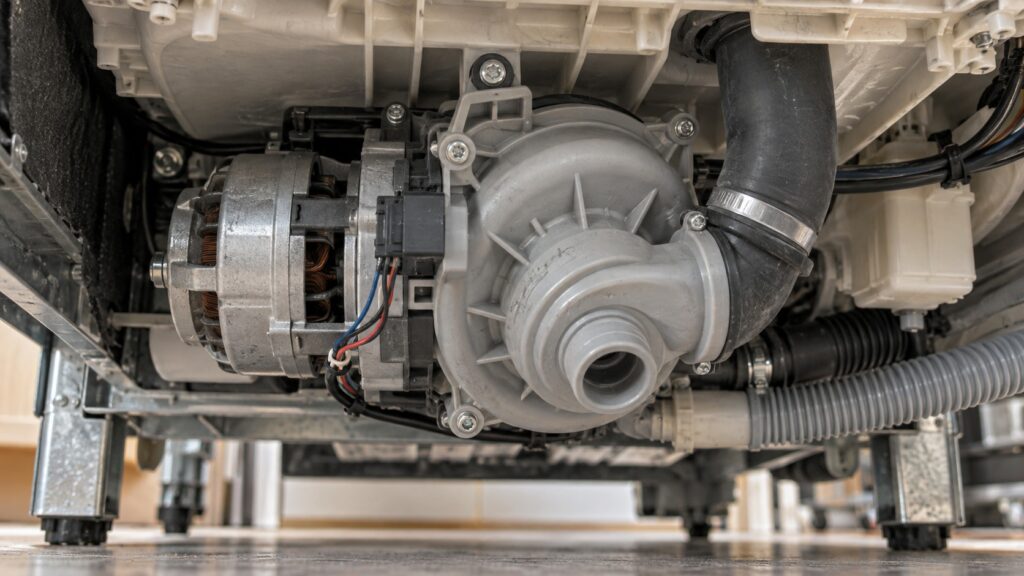
Five Miele dishwasher numbers all describe one part: the circulation pump, the motor that drives water up to the spray arms. The F67 error code dishwasher owners see most often means the pump is not holding the speed the program asked for. F68 means it will not stop. F69 means it is blocked, F78 blames the electronics that drive it, and F53 the sensor that reports its speed. One component, five ways of failing.
Knowing that saves you from the usual detour. These codes send people to filters, spray arms and detergent, and while a blocked filter can certainly starve the pump, the code itself is pointing at the motor, not at the dishes.
What is the circulation pump doing in the first place?
It is the only thing pushing water through the machine during a wash. Water collects in the sump under the filter, the circulation pump lifts it under pressure, and the slide shutter steers it to the lower arm, the upper arm or the third-level spray bar. Everything the machine does during a wash phase depends on that flow: the heater will not switch on without it, the wash pressure that actually removes food comes from it, and the control watches its speed the whole time.
That is why the motor is speed-controlled rather than simply on or off. Different phases ask for different pressures, and the control checks constantly that the motor is delivering what was requested. When the measured speed and the commanded speed disagree, one of these codes appears.
What is the difference between F67, F68 and F69?
They describe three different disagreements, and they lead to three different conversations with a technician.
- F67 — speed wrong. The pump turns, but slower or faster than commanded. A partial obstruction, worn bearings or a drive fault will all do this.
- F68 — the pump will not stop. That is a drive or control problem far more often than a motor problem, because stopping is a command rather than an effort.
- F69 — blocked. Something is physically holding the impeller: a shard of glass, an olive pit, a fruit sticker or a piece of a label that got past the filter.
F78 and F53 sit slightly apart. F78 points at the electronics driving the motor, and F53 says the speed signal is missing entirely, so the control has nothing to compare against. Full detail for each is on the code pages: F67, F68, F69, F78 and F53.
What do these faults sound like?
Listen to the machine before you open anything. A healthy Miele wash phase is a steady low hum with the spray arms audible as a soft rhythmic sweep. The pump codes each change that sound in a recognizable way. A blocked impeller grinds or rattles and then goes quiet as the motor gives up. A speed fault often produces surging, where the sound rises and falls as the control keeps correcting. A pump that will not stop leaves the machine humming after the cycle has finished, sometimes with the door already open.
One more observation is worth making: does the fault appear at the same point in every cycle? A code that always lands in the main wash points at load on the pump, and a code that appears in a short rinse phase points at the drive or the sensor.
What can you check yourself, and where do you stop?
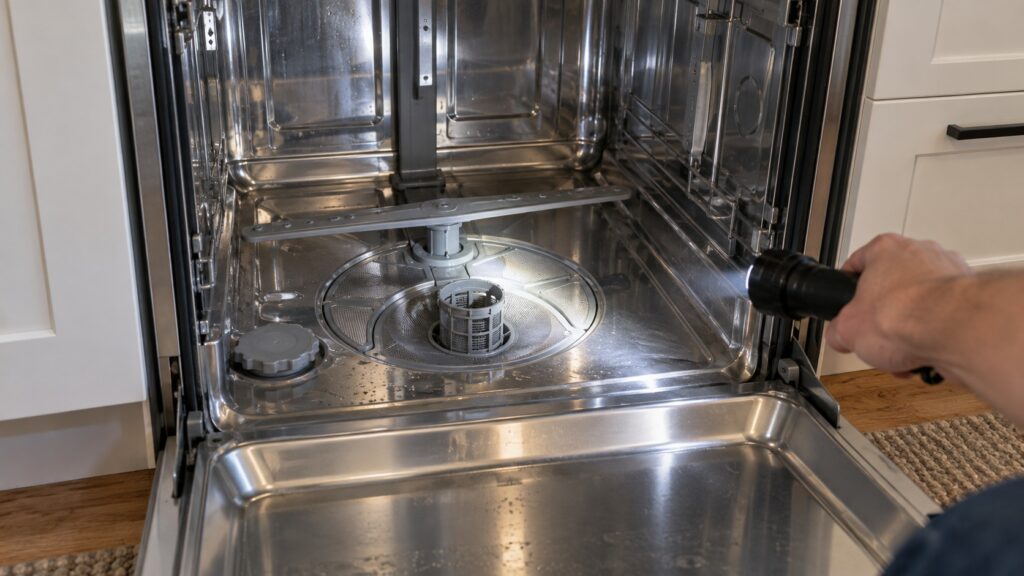
- Take out the triple filter and look into the sump. Use a flashlight. Glass fragments, pits and stickers settle there, and a blocked pump often has its cause in plain sight. Our filter cleaning guide shows how the assembly comes apart.
- Feel around the filter recess with a gloved hand, not a bare one. Broken glass is the single most common blockage, and it does not announce itself.
- Cut the power for two minutes and run a short program. A latched pump code that clears and stays away was probably caused by something that has since washed through.
- Run the machine empty and listen through the whole cycle. You are trying to place the sound in time, not to fix anything.
That is the boundary. The circulation pump sits under the tub, its housing is part of the sealed water circuit, and reaching it means laying the machine over and disconnecting mains wiring next to standing water. Removing the pump is also the step where an intact seal most often gets damaged, which turns a pump fault into a leak.
Is a pump code the same as a dishwasher that is not cleaning?
No, and the difference decides where to start. A machine that cleans badly with no code is usually a water, filter or loading matter, and the not-cleaning guide works through that. A machine showing a pump code has already tested its own motor and found it wanting. If you see both — poor cleaning and one of these five numbers — trust the number.
It is also worth separating these from drainage. The drain pump is a different, smaller motor that empties the machine at the end of a phase, and it has its own code. If water is standing in the bottom rather than circulating badly, read the F11 drainage guide instead.
Is it worth repairing?
Usually, yes. The circulation pump is a replaceable part on every current Miele dishwasher family, the repair does not touch the control board, and a blockage cleared early is often no parts at all. What changes the arithmetic is running the machine for weeks on a known pump code: a motor fighting an obstruction takes its drive electronics with it eventually, and then two parts are involved instead of one. Our repair or replace guide covers where the line falls.
We are an independent repair company, not a factory service arm, and we will tell you when a repair is not worth doing. Pricing starts from a diagnostic visit, from $89 in most of our service area, and we confirm the estimate before any work begins.
When the sump is clear and the code is still there, Miele dishwasher repair is the next step. Schedule a visit with the code, the phase it appears in and what the machine sounds like; those three together usually identify the part before anyone opens the cabinet.