The question of a Miele dishwasher hot or cold water connection is answered by the installation instructions for your exact model, not by what the old dishwasher used or what the plumber is used to. Our pages do not give the rule for each model, so we will not state one. What they do say is that our fill-codes guide describes F15 as a hot-water inlet problem, meaning the supply is too cold or hot and cold are reversed, which tells you that the supply the machine is connected to matters and that mixing them up shows up as a fault. Check the instructions before the plumber starts, have the connection made by a professional and confirm the supply on the first run.
Why does the choice of hot or cold supply matter?
A dishwasher is designed around a particular kind of supply, and the control expects it. If the supply does not match what the instructions for your model call for, the result you see can be a cycle that behaves oddly, an error code or a wash that does not clean as it should. We do not say here which supply that is for any model, because that is for the installation instructions and the installer to settle.
Which supply suits your Miele dishwasher is a design decision made by the manufacturer, so the answer is in the instructions that came with it. If you no longer have them, our G-series model pages list the model families, and the manual for your exact model is the place to look. Do not copy the connection from the old dishwasher without checking, because a previous machine, or a previous installer, may have used a different supply.
What does the F15 code tell you?
Our Miele dishwasher fill codes guide describes F15 as a hot-water inlet problem, with two causes: the supply is too cold, or hot and cold are reversed. That is a useful clue for installers and owners. It means that if you see F15 on a new installation, check which supply the machine is connected to before you do anything else, and compare it with the instructions.
The same guide gives other fill codes that point away from the supply: F13 for a fill that fell short, F12 for no water at all and F18 or F19 for the flow meter. Write down the exact code and use the guide to tell them apart. Our pages do not say which supply each model expects, so do not read this as a rule that every Miele dishwasher is a hot-supply machine.
How do you check the supply before the first cycle?
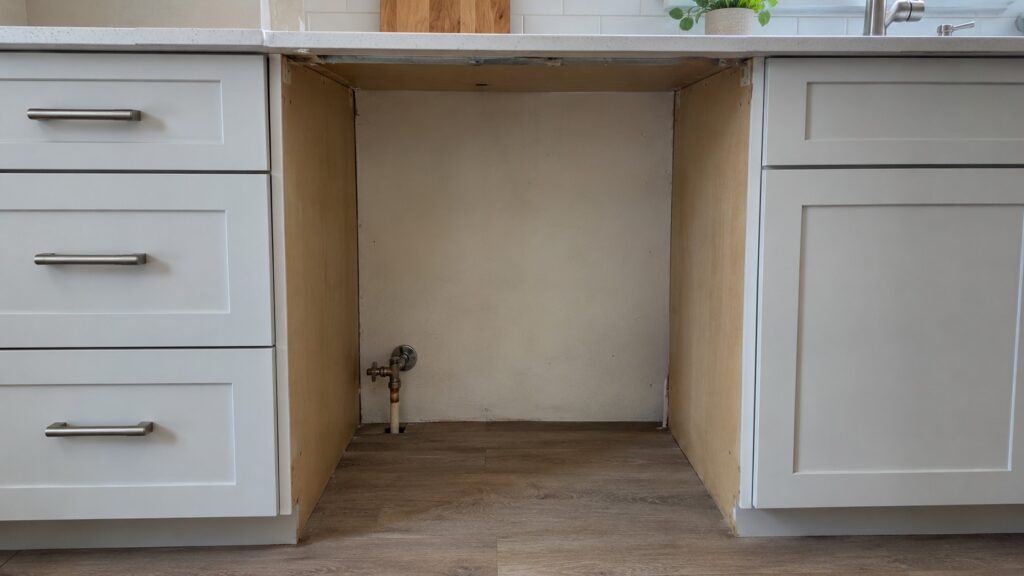
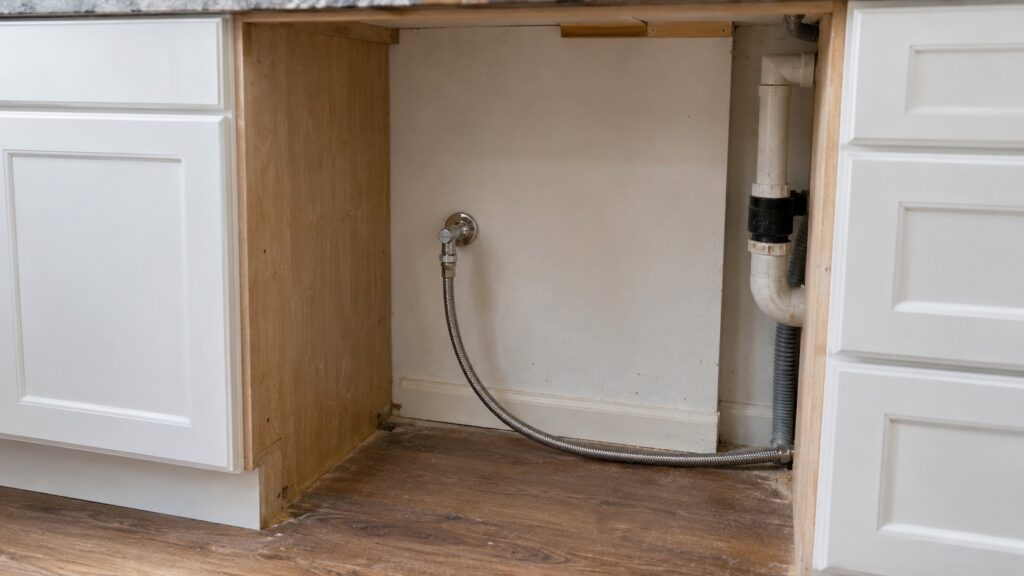
Look at the connection and the valve, without touching the fittings. The shutoff valve should be reachable, fully open and not leaking; our fill-codes guide lists a closed or partly closed valve among the first things to check. Look that the supply line is not kinked or crushed behind the dishwasher. Anything about the fittings, the line or which supply is used belongs to the plumber or installer.
If you are not sure which supply the instructions call for, or which pipe is which, do not guess and do not test the pipes yourself. Ask the plumber or installer to confirm it against the instructions and to label the valve, because a wrong connection can be harder to find later.
What else belongs in the water connection?
The supply is only part of it. Our Miele dishwasher installation guide lists the checks that prevent first-cycle problems: a high loop or air gap for the drain hose so dirty water cannot siphon back, removing the disposer knockout plug if the drain goes to a disposer, leveling the cabinet and filling the softener salt with the hardness set for your water. Our dishwasher not draining F11 guide explains why a missing loop or a forgotten plug is the classic no-drain problem on day one.
Miele dishwashers also have a Waterproof System float that stops the cycle if water reaches the base pan. Our F70 guide says that F70 means the float sensed water in the base pan. If you see water on the floor after the first cycle, stop the dishwasher and call the installer; do not tighten the connections yourself.
What should an owner do, and what should a plumber do?
As the owner, you read the instructions, tell the plumber what they say, check the valve and the line when the work is done, and watch the first cycle. The plumber makes the connection, chooses a line and fittings that suit your model and the local code and tests it for leaks. Leave the fittings, tape and sealant to them: an owner should not tighten, re-seat or force a supply line.
Do not try to connect, change or move the supply yourself. If water is leaking, close the shutoff valve only if you can reach it safely and the floor and outlet are dry. If water reaches an outlet or the cord, switch off the breaker at the panel while standing on a dry floor, and do not pull the plug out of a wet outlet.
When should you call a technician?
Call when a code such as F15, F13 or F12 returns after you have checked the valve and the line, when the cycle never seems to get hot or when water appears anywhere it should not. We are an independent repair company, not an installer. Our Miele dishwasher repair page explains how a visit works, and you can book a visit online.