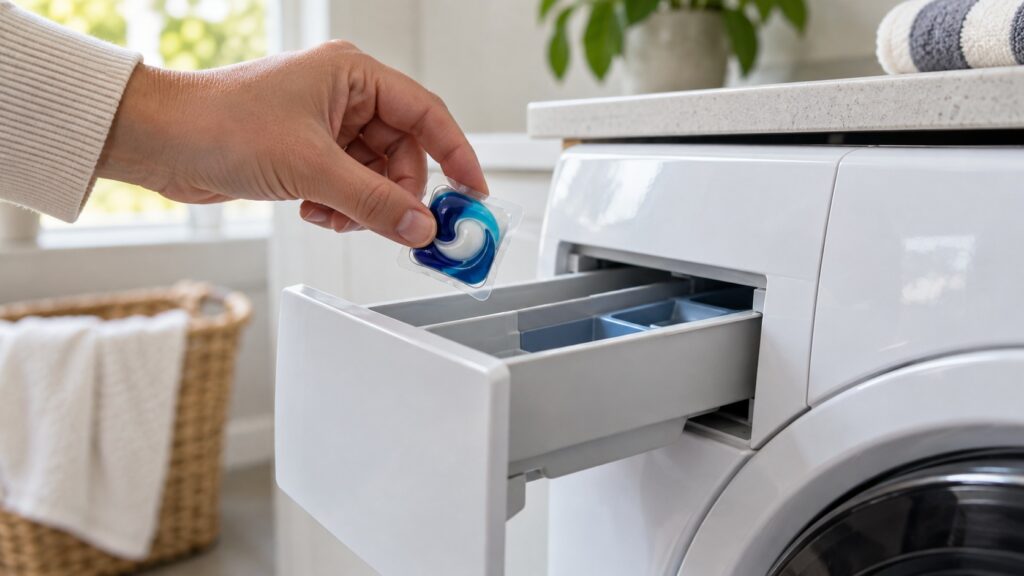
CapDosing is Miele’s single-use capsule system: a small sealed cap that drops into a compartment in the dispenser drawer and releases its contents at the right moment in the cycle. It appears on W1 washing machines and on some dishwashers, and it is the entry-level answer to the same question TwinDos answers at the top of the range — how much detergent, and when.
What Miele CapDosing does during a cycle
The capsule is not dissolved by being soaked. The machine punctures it and flushes it at the point in the program where its contents belong — a fabric conditioner late, a booster early, a wool care product with the gentle wash. That timing is the whole point. Pouring the same liquid into the main chamber puts all of it into the first fill, where much of it is rinsed away before it can do anything.
Because dosing is fixed by the capsule, there is nothing to measure and nothing to overdose. Over-dosing is the single most common cause of the residue and odor complaints we are called about, so a system that makes it impossible removes a whole class of problem. Our guide on how Miele TwinDos works covers the refillable alternative, which solves the same problem differently.
Capsules are not the main detergent
This is the misunderstanding that causes trouble. A CapDosing capsule holds a small volume — enough for a conditioner or a specialist treatment, not enough to wash a full drum of cottons. If you drop a capsule in and leave the main chamber empty, the load gets a fraction of the detergent it needs, and the result looks like a machine that no longer cleans.
- Main detergent still goes in the main chamber — as powder or liquid, dosed for the load and the water hardness.
- The capsule compartment is separate and holds one capsule per cycle.
- One capsule, one wash. They are not resealable and a half-used capsule will leak into the drawer.
- Match the capsule to the program. A wool capsule in a cottons program does nothing useful.
What goes wrong, and what it looks like
CapDosing has almost no mechanism, which is exactly why it is on the entry models — there is very little to fail. What does happen is the drawer. A capsule that was not seated properly, or one left in from a previous cycle, blocks the flush path, and the symptoms are a sticky dispenser drawer, conditioner appearing on clothes as marks, or water backing up in the drawer during fill.
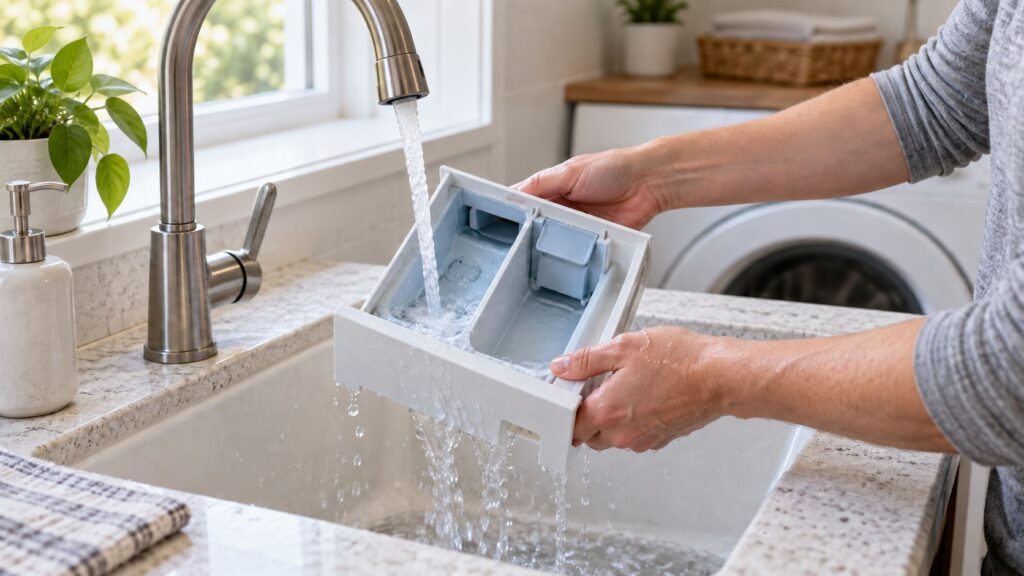
All of that is a cleaning job. The drawer comes out, the compartment rinses under warm water, and the flush holes above it clear with a soft brush. Do it every couple of months and the problem does not appear. If the drawer is clean and the machine still floods it, that is a valve or a pressure fault rather than a dispenser fault, and our page on a Miele washer that will not fill is the right place to start.
Hard water, dosing and why the two are linked
Dosing is not a fixed quantity in the abstract — it is a quantity for a given water hardness and a given load. In a soft-water area a standard dose cleans thoroughly and rinses out cleanly. In a hard-water area the same dose is partly consumed neutralizing the minerals in the water before it ever reaches the fabric, which is why people in hard-water households instinctively add more and then meet residue problems from the other direction.
CapDosing sidesteps the argument for the products it covers, because the capsule volume is set for the job. It does not sidestep it for the main detergent, and that is where a hard-water household still has to think. The machine’s own water-softening arrangements and the maintenance program between them decide whether limescale accumulates on the heater, and a scaled heater is a slow, quiet failure that shows up as longer cycles and, eventually, a heating fault.
Storage, shelf life and the small print
Capsules are sealed, so they keep well, but they are not indestructible. Two things shorten their life. Heat, which thins the contents and can start them weeping at the seam; and a damp cupboard, which softens the outer material until a capsule deforms and no longer seats squarely in its compartment. A capsule that does not seat is the usual reason one fails to be dosed at all.
Keep them somewhere dry and at room temperature, keep them in their box rather than loose in the drawer under the machine, and check the seam before dropping one in. A capsule that already looks wet on the outside will mark the compartment rather than dose the wash.
Which machines have it
CapDosing is a W1 feature and it spans the range rather than marking a tier. The entry W1 uses CapDosing as its whole dosing story. Upper models pair CapDosing with TwinDos, so the cartridges handle the main detergent automatically and the capsule handles the extras. Our W1 washer buying guide sets out which model does which, and the important point there holds here too: the mechanism that decides how long a machine lasts — drum, bearings, suspension — is the same whichever dosing system it carries.
Keeping the dispenser working
Three habits keep the system trouble-free. Take the drawer out once every month or two and rinse it, including the capsule compartment. Run the machine’s own maintenance program at a high temperature every few months so residue does not build up in the parts you cannot reach — our guide on descaling a Miele washer covers when hard water makes that more urgent. And leave the door and the drawer ajar after the last wash of the day so the machine dries out.
If dosing looks wrong after all of that — clothes coming out with residue, or a conditioner that never seems to arrive — it is worth having the dispenser checked rather than buying more product. We are an independent repair company, not a factory service arm; pricing starts from a diagnostic visit and we confirm the estimate before any work begins. Miele washer repair covers the dispenser and fill circuit, and you can schedule a visit online.