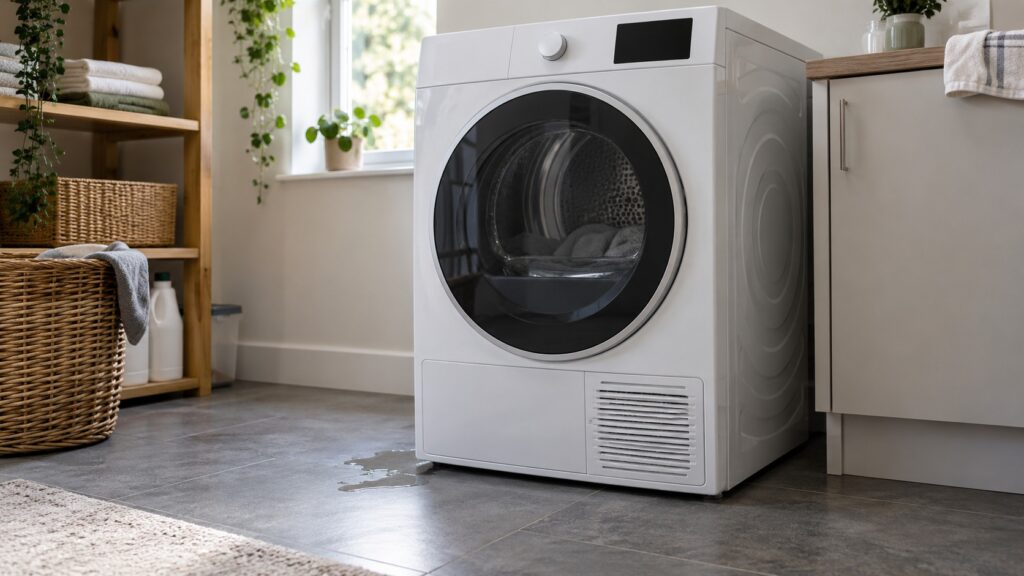
A Miele condenser dryer leaking water is usually leaking from its condensate path, not from the drum. The T1 heat-pump dryers on our site remove moisture from the laundry and condense it into water, which collects in a container you empty after each load unless the dryer is plumbed to a drain. Water on the floor most often means that container is not seated, the float is stuck, or, on a plumbed install, the drain hose is loose or kinked. Treat any water around an electrical appliance with care, and call us if it does not stop after the simple checks.
Why would a Miele condenser dryer leak water?
Our heat-pump dryer guides explain the basics. A Miele T1 heat-pump dryer recirculates air instead of venting it outside, and the moisture it pulls from the laundry condenses to water. That water goes to a container that you empty each load, or to a drain if the optional drain hose is fitted. Because the dryer makes water by design, a leak is a failure of the path that carries it, and that is a smaller list than it sounds: the container, the float and level sensor, the hose and the condensate pump on plumbed installs, and, as a setup point, the level of the machine itself.
You may also see this dryer described as a condenser dryer in searches. On this site the dryers are the T1 heat-pump models, which do the same job of condensing moisture, so the advice here applies to them. If your dryer is a different type, follow your manual.
What should you check first?
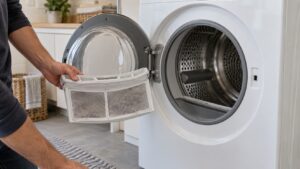
Start with the safe checks. Our empty container guide says a misseated tank reads as full and can misbehave, so empty the condensate container and reseat it fully. Check that the float inside the tank moves freely and is not stuck with lint or scale. Wipe the tank contacts and the recess, because our guide says that helps the level sensor read correctly. Scale from the condensate can foul the float over time, so rinse the tank as the manual describes.
Look at the floor under and around the dryer as you do this, and note exactly where the water is. Water at the front near the container points one way, water near the back where a hose might connect points another. Take a photo; it helps when you call. Our Miele dryer empty container guide explains the container prompt in detail.
What if the dryer drains to a hose or standpipe?
If the dryer is plumbed, the drain path is longer. Our installation guide says that water pooling under a plumbed install points to a loose or kinked condensate hose. Check that the drain hose is not kinked or blocked and that it is connected firmly at both ends, and that the condensate pump runs, as the empty container guide describes. A blocked path can also slow drying, so a dryer that leaks and also takes longer than before is worth reporting together.
The installation guide also lists leveling the dryer as part of setup. A dryer that has been moved, or that sits on an uneven floor, is worth rechecking for level while you look at the container. Our Miele dryer installation guide covers leveling and the choice between the container and a drain. Do not move a dryer with water in the container or the hose, because it can spill.
How do you stay safe around the water?
Water and electricity do not mix. If water has reached an outlet, a cord or the back of the dryer, switch off the breaker at the panel while standing on a dry floor, and never pull a plug from a wet outlet. Mop up, dry the area and keep children and pets away. Do not run the dryer again until you know where the water came from.
Do not open panels or reach behind the cabinet to look for the source. The heat pump is a sealed system and the condensate pump and wiring sit inside the cabinet, so that is a technician’s job. Only the container, the filters and the parts the manual shows you are owner tasks.
Could blocked airflow be part of the problem?
It can add to it. Our guides say heat-pump dryers depend on clean filters and a clear heat exchanger, and that a blocked path can slow drying and trigger codes such as F66. Keep the filters clean so airflow stays clear. Our Miele dryer filter cleaning guide covers the door filters, and heat exchanger cleaning covers the base. If clothes come out damp as well, read Miele dryer not drying.
When should you call a technician?
Call if the leak returns after you have emptied, reseated and checked the container, if water appears from the base or from somewhere other than the container area or the hose, if the container fills unusually fast, or if the condensate pump does not run on a plumbed install. Our container fills fast page describes that symptom, and our Miele dryer repair page explains how a visit works. For an older dryer with several problems, repair or replace is worth reading first.