
A Miele dishwasher F14 is a heating-circuit fault: the control lost the signal it needs from the heater pressure switch before it would allow the water to be heated. Four neighboring numbers describe the same circuit from other angles, and that is why dishes come out lukewarm and filmed rather than clean. None of these codes is a drain problem, a spray-arm problem or a detergent problem, even though the plates look exactly like all three.
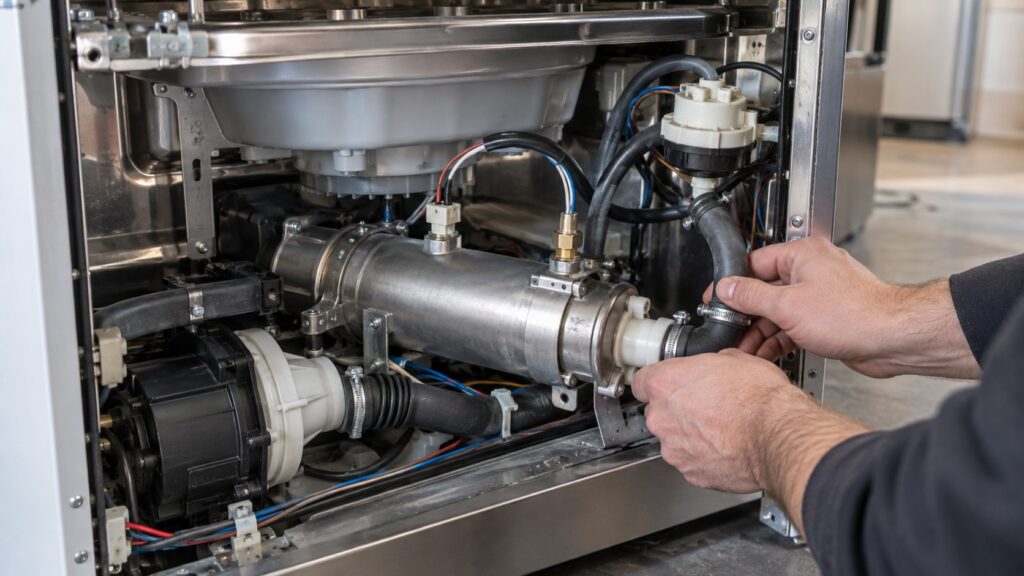
Miele heats wash water in a flow-through heater built into the circulation path. Water has to be moving past it before a single watt is allowed, and a pressure switch is what proves the water is there. Every code below is part of that proof chain.
What does F14 mean on a Miele dishwasher?
Take a Miele dishwasher F14 literally: the machine wanted to heat and was not given permission. The pressure switch sits in the water circuit and closes only when the circulation pump has established flow. Until that contact closes, the heater stays off. So F14 appears either when the flow is genuinely too weak to close the switch, or when the switch itself no longer reports a flow that is actually there.
That second possibility is the reason this code frustrates people. The machine sounds normal. Water goes in, the pump runs, the cycle finishes on time. Only the temperature is missing, and temperature is the one thing you cannot see through a closed door.
Why do five codes point at one heating circuit?
Because Miele separates the failure modes instead of lumping them together. F14 and F51 concern the signal path — a switch or an NTC temperature sensor that is not saying what it should. F24 concerns the relay that actually switches power to the heater. F25 is the outcome code: the water never reached the temperature the program asked for, whatever the reason. F52 is the safety end of the chain, raised when the pressure switch trips and cuts the heater off.
Read as a group, they form a sequence rather than a list of five unrelated problems. Weak circulation trips the switch, which stops the heating, which means the target temperature is never reached. It is common to see F14 on one cycle and F25 on the next, and people reasonably assume a second fault has appeared. Usually it has not.
What does a heating fault look like from outside the machine?
The tell-tale signs are on the dishes, not on the display:
- A greasy film on glassware that wipes off with a thumb. Detergent enzymes need heat, and below roughly 120 °F they leave fats behind.
- Cold dishes at the end of the cycle. A normally finished Miele load is warm to the touch when the door is opened.
- Poor drying even with the rinse aid topped up, because drying on most models rides on the heat left in the load and the tub.
- A cycle that runs long while the machine waits for a temperature that is not arriving.
- Detergent left in the dispenser or only partly dissolved.
If the dishes are cold but the machine shows no code at all, the fault is more likely in the wash mechanics than in the heater. Our guide on a Miele dishwasher that is not cleaning covers that path, and the drying guide covers the end of the cycle.
What can you check without opening the machine?
Three things are worth doing before anyone quotes you a part.
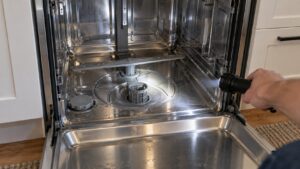
- Clean the triple filter. A clogged filter starves the circulation pump, weak circulation fails to hold the pressure switch closed, and a heating code follows. Lift the assembly out, rinse it under a hot faucet and refit it. This is the cheapest fix behind a Miele dishwasher F14 and it is genuinely common.
- Check the supply temperature. Run the hot faucet nearest the machine until it is fully hot and measure it if you have a kitchen thermometer. A supply near 120 °F leaves the heater with far less work to do than a supply at 90 °F, and a machine on a long cold run raises temperature codes more often.
- Run a hot cycle empty with a dishwasher cleaner if the machine has been on hard water without salt. Scale on the heater surface slows heat transfer before it stops it.
Do not go further than that. The heater, the pressure switch and the relay on the control board are inside the sealed cabinet, and the heater circuit carries mains voltage within inches of standing water. That combination is the one place in a dishwasher where guessing is genuinely dangerous.
Does F25 mean the heating element has failed?
Not by itself. F25 states that the target temperature was not reached; it does not say which link broke. We see it caused by a starved circulation pump, a scaled heater, a drifted NTC sensor and a tired relay, in roughly that order of frequency. An open heating element is real but it is not the first suspect, and replacing one on the strength of the code alone is how people end up paying twice.
The individual code pages give the per-number detail: F14, F24, F25, F51 and F52. Reading two or three of them together is usually more informative than reading one, because the machine often has more than one to show.
When is a heating code worth repairing?
On a Miele dishwasher, usually yes. These machines are built for a long service life, the heater and its sensors are serviceable parts rather than sealed assemblies, and a heating fault leaves the rest of the machine untouched. The calculation changes only when the control board is implicated alongside the heater, which is the one combination where the honest answer can be replacement. Our repair or replace guide sets out where that line sits.
We are an independent repair company, not a factory service arm, and we will tell you when a repair is not worth doing. Pricing starts from a diagnostic visit, from $89 in most of our service area, and we confirm the estimate before any work begins.
When the filter clean and the hot-supply check have not moved it, Miele dishwasher repair is the next step, and you can schedule a visit with every code the machine has shown written down in the order it showed them. That order is the part a technician cannot reconstruct afterward.